Art of the Buddha
To view this page in another language, please click here:
To translate this entire site, please click here:
Indigenous Peoples Literature


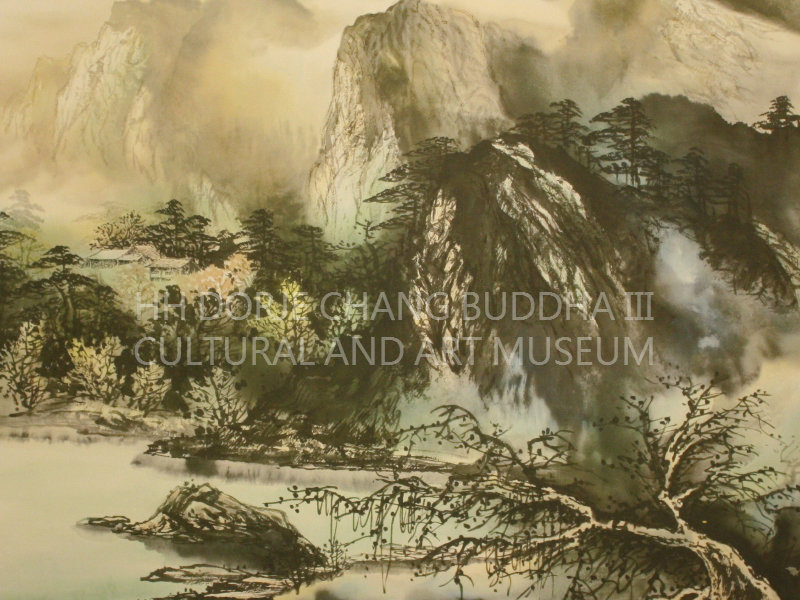
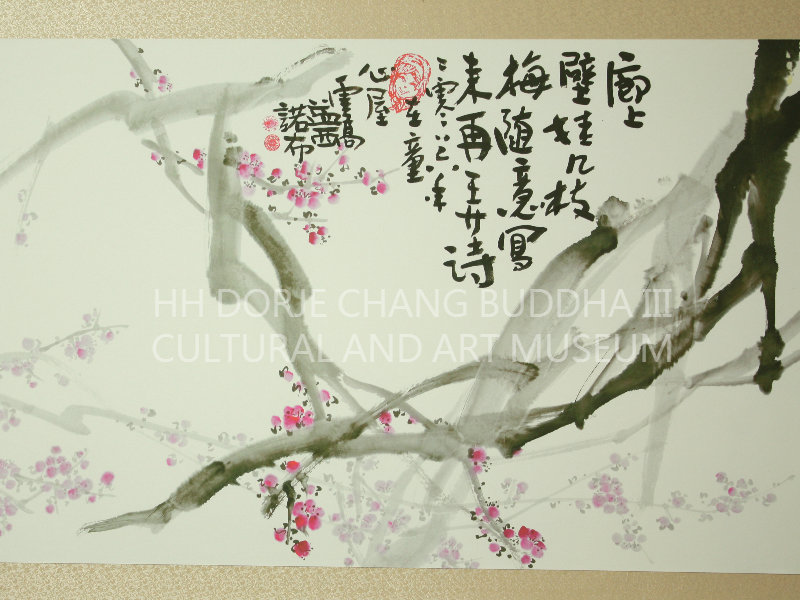
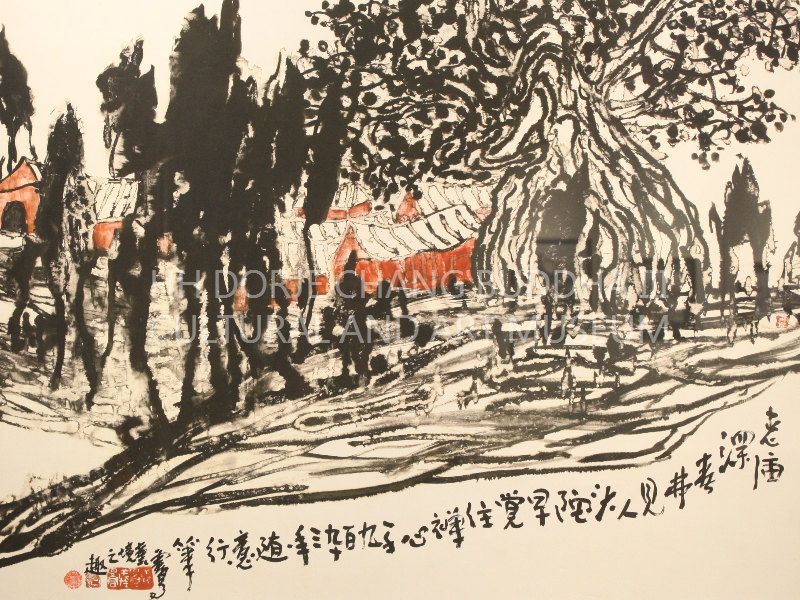
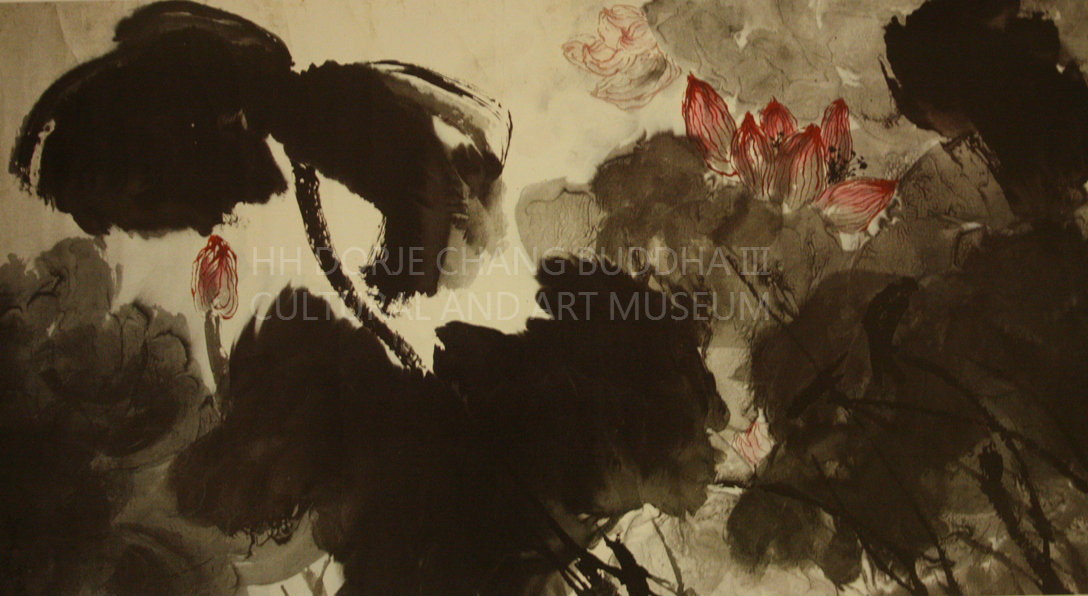
The 4 paintings below sold for over $30,000,000!
“Ink Lotus” - $16,500,000.

This painting was sold at the highest price.
Surpassing that of works by renowned artists past and present.
Trumping by multiple times the selling price of all works by famed historical
and contemporary masters sold at Gianguan Auctions.
"Loquat" - $10,200,000.

This painting is charismatic and unfathomable.
The brush strokes are miraculous and with infinite charm.
‘Loquat’ is a remarkable painting.
A few strokes are able to express a broad view of great insight.
The movement is lyrical and elegant; simple and tranquil.
Setting a world record price of $1.7M per square foot.
"Venerable Da Li Wang (Sadapralapa)" - $2,207,912.

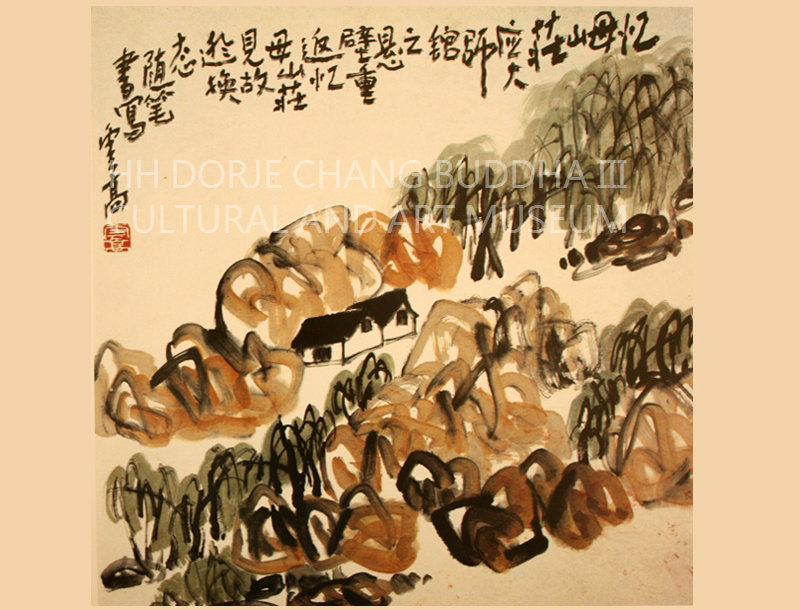
Calligraphy, poetry and prose are always key elements in Chinese paintings.
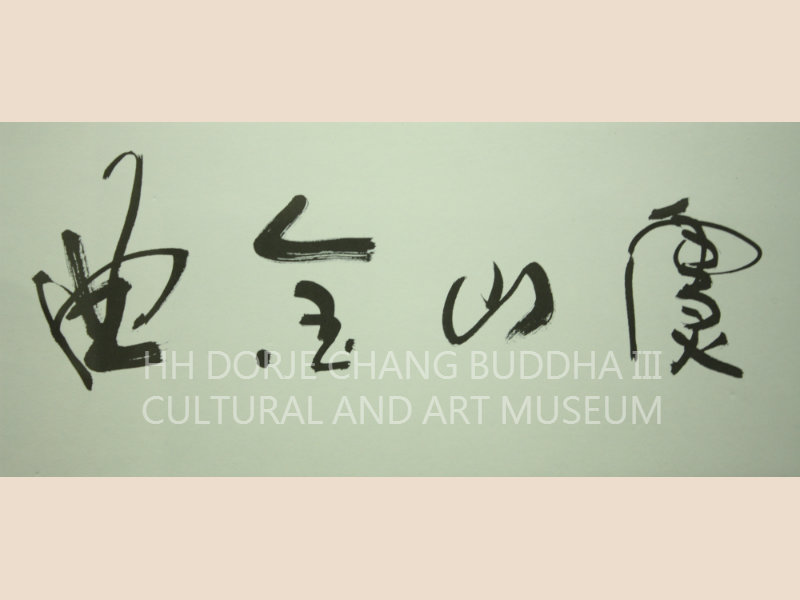
"Wei Zhen (Majesty)" - $2,125,327.

It is noted that the artist is one of the top ten contemporary artists
of Chinese ethnicity capturing the attention of the international auction market.
Buddhism is among the largest religions in this world. The original founder of Buddhism and the religion’s highest spiritual leader in the universe is Dorje Chang Buddha. He is worshiped by all major sects and schools of Buddhism as the earliest primordial Buddha.
Buddhists belong to a religious belief that understands the universe’s nature of no-birth and no-annihilation and human beings’ original nature of true such-ness are one and the same. They believe in the cycle of transmigration driven by the law of cause and effect.
Buddhism is among the largest religions in this world. The original founder of Buddhism and the religion’s highest spiritual leader in the universe is Dorje Chang Buddha. He is worshiped by all major sects and schools of Buddhism as the earliest primordial Buddha.
Buddhists belong to a religious belief that understands the universe’s nature of no-birth and no-annihilation and human beings’ original nature of true such-ness are one and the same. They believe in the cycle of transmigration driven by the law of cause and effect. They believe that after one’s biological death, the spirit or soul will incarnate and be reborn into a new being. In the case of the primordial Buddha, He has now incarnated to this world for the third time as His Holiness Dorje Chang Buddha III. The highest spiritual leader in Buddhism alive today currently lives in the United States of America.
His Holiness Dorje Chang Buddha III is not one who seeks publicity. Even when awarded the Presidential Gold Award, the Dr. Martin Luther King Legacy Award for International Service and Leadership, and many other prestigious prizes, He did not attend the award ceremonies to receive the prizes in person. He is well known for loving-kindness and compassion, and has made a vow of only helping others and never accepting any offerings from anyone.
However, His accomplishments and accolades are widely-reported. The following are five of the most interesting things that you may not have known about His Holiness the Buddha:

1. Buddhism classifies all material and spiritual matters and knowledge in the universe into five aspects. Complete mastery of these five aspects is called having realized the Five Vidyas (vidya is a Sanskrit word meaning brightness). Buddhas and Bodhisattvas must possess the Five Vidyas. The Five Vidyas include: the Vidya of Causality, the Vidya of Healing, the Vidya of Sound, the Vidya of Craftsmanship, and the Vidya of Inner Realization. Looking through the entire history of Buddhism, His Holiness Dorje Chang Buddha III is the first holy one to perfectly manifest real accomplishments in the Five Vidyas, meeting the highest standard of Buddhism. For this reason and more, His Holiness Dorje Chang Buddha III is the one and only individual in history to receive recognitions and corroborating recognitions from over 60 of the highest present-day dharma kings and regent dharma kings from various Buddhist sects.
2. His Holiness Dorje Chang Buddha III was awarded the Top Honor Prize during the World Peace Prize Ceremony at the U.S. Capitol on June 14, 2011. The World Peace Prize is an initiative to promote world peace and understanding between different nations, ethnicities, cultures and religions.His Holiness Dorje Chang Buddha III was recognized for receiving this Top Honor Prize by the 112th Congress in U.S. Senate Res. 614, commending His Holiness the Buddha for his role in advancing peace, justice and inter-religious collaboration.
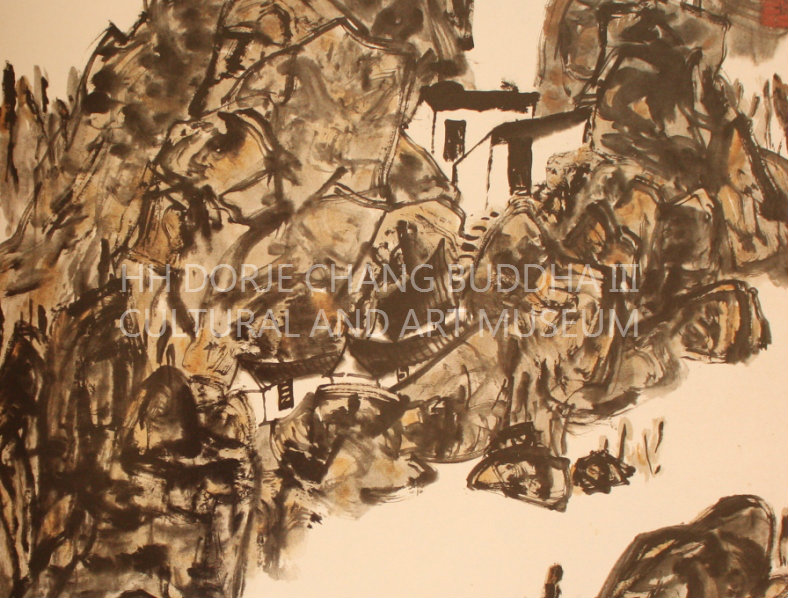
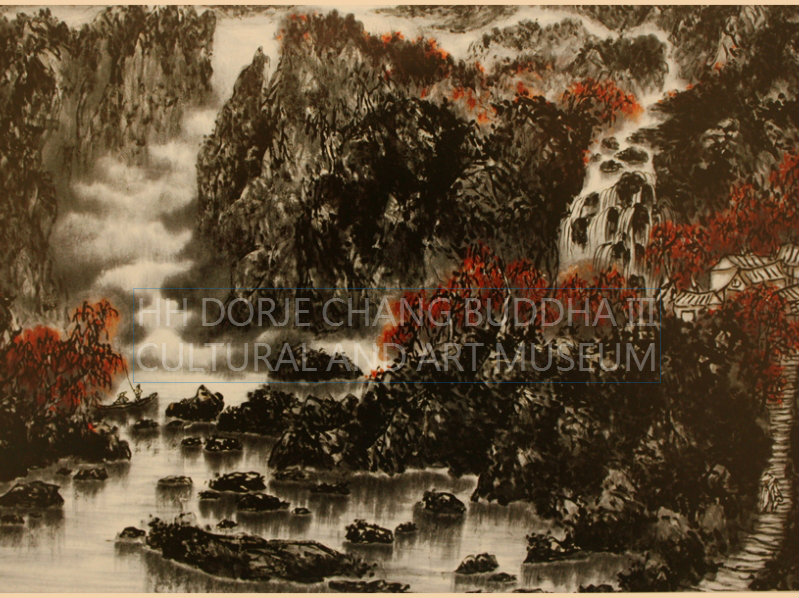
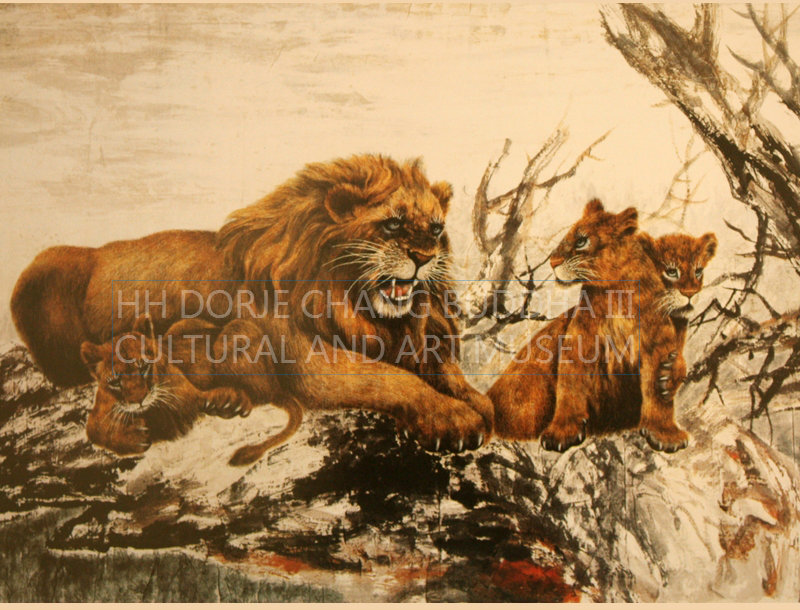
3. His Holiness Dorje Chang Buddha III has long been an internationally renowned artist. His paintings are not limited by subject or themes and are of many types, from water-ink paintings to oil paintings. Specifically, the subject matters include human figures, animals, flowers and birds, mountain and water scenes, fish, insects, and so on. Within the wide range of styles, there is fine brushwork, drawing with lines and strings, splash-ink, bold freehand brushwork, small freehand brushwork, and others. Altogether, He created 16 unique painting styles or schools, representing an unprecedented pioneering achievement in the history of art. His paintings are on permanent exhibition at the International Art Museum of America in San Francisco, the H.H. Dorje Chang Buddha III Cultural and Art Museum in Los Angeles County, and other art museums. His Holiness Dorje Chang Buddha III’s paintings are extremely valuable and rare. As early as in 2000, His artworks were sold for more than two million U.S. dollars each. He became the artist whose paintings commanded the highest prices compared to the prices for paintings created by all ancient and modern Chinese artists. Last March, an ink painting of His was sold at the New York Spring Auction for $16.5 million, which was the highest price realized at the 2015 Spring Auction of all artworks by ancient and modern artists worldwide. He is the world’s first inventor to create a class of artworks that cannot be duplicated by anyone or with any method — Yun Sculpture. Only after that, the world now has un-duplicable artworks. Experts predict that His paintings will become increasingly valuable as His Holiness plans to focus solely on Buddhist activities.

4. In 2011, the then Mayor of Washington, D.C., Vincent Gray, proclaimed January 19th as “H.H. Dorje Chang Buddha III Day.” The mayor called on D.C. residents to join him in saluting “His selfless and exceptional work to spread the word of peace to all those in His presence.” The Unites States Postal Service also issued a commemorative cover in celebration of “His Holiness Dorje Chang Buddha III Day.”
5. His Holiness Dorje Chang Buddha is a Fellow of Britain’s Royal Academy of Arts, making Him the first internationally distinguished artist appointed to a Fellowship in the Academy’s history of more than 200 years. The title of Fellow was awarded by the Academy’s President, Phillip King, at a ceremony in the British Embassy in Washington.
Unless you are an astute follower of Buddhism, you may not have known that His Holiness Dorje Chang Buddha III has been recognized as the third incarnation of the original Buddha. His accomplishments clearly transcend religion, healing, art, philosophy, and literature. He continues to devote His time to a wide scope of cultural, religious, and various other domains directed at helping people in communities across the globe. His Holiness Dorje Chang Buddha III has made the following vow: “I will bear all of the karmic offenses committed by living beings, and I will give everyone all of the good karma and merit that I plant.” His Holiness the Buddha has been executing it exactly as is.
From ancient times to the present, no product of an art or field of study has been able to reflect a person’s moral character and knowledge---except for calligraphy. The aura created by a person’s achievements or creations in a certain form of art or field of study often covers up his shortcomings in knowledge and character. However, calligraphy is an exception to this rule. Calligraphy is like a three-dimensional projecting mirror. The depth of one’s knowledge, the level of one’s moral character, and the strength of one’s mind are revealed through each stroke of the brush. There is no way to conceal such things. When looking at the quality of a person’s ordinary writing of Chinese characters, most people can discern the level of that person’s education. This is all the more true with respect to looking at a person’s calligraphy.
One cannot find in any history book an unknowledgeable person who has made a contribution to calligraphy. Those with profound and extensive knowledge are not necessarily proficient in calligraphy. However, a great calligrapher must have both knowledge and good brushwork. Without exception, all of the famous calligraphers throughout the generations were great masters of literature who had profound knowledge. Examples of this include ancient calligraphers such as Xizhi Wang, Su Huai, Shaoji He, Huaiguan Zhang, and Fei Yue. A modern example is Youren Yu. Each one of them was an extremely learned literary giant and paragon of virtue.
Knowledge is the pillar and cornerstone of calligraphy. Moral character can be seen in the style and charm of calligraphy. Thus, calligraphy requires both knowledge and moral character.
The calligraphy of H.H. Dorje Chang Buddha III is not bound by worldly conventions and is devoid of unnecessary flamboyance. It is highly refined and based upon ingenious artistic conception. His Holiness’s strokes are sometimes written in a swift curling style. However, in an instant, His Holiness can express the innocent and natural charm of a child. There is wonder in even common strokes. His calligraphy is naturally graceful, exhibiting depth and brilliance. The calligraphy of His Holiness contains an invisible force that makes the characters seem much grander than they appear on a superficial level. His strokes look harmoniously smooth and unbroken. The Chinese characters may appear strong and vigorous, like a soaring dragon or mighty tiger. They may appear clear and gently elegant, like slowly floating clouds, cranes flying among pine trees, or dancing swans. They may appear simple and unadorned, like the free heart of a child. They are gracefully understated and completely devoid of any mundane quality. The calligraphy of H.H. Dorje Chang Buddha III is natural in quality and resonates with the true nature of the universe. A deep power underlies His Holiness’s strokes.
The ability of H.H. Dorje Chang Buddha III to reach such great heights in calligraphy is completely due to His Holiness’s vast knowledge and profound talents. Of course, His Holiness is extremely adept at learning from the styles of others since this is a simple matter for a Buddha. For example, even in the initial stage of learning calligraphy, H.H. Dorje Chang Buddha III had solid skills in the traditional cursive style of writing and also had extensive learning. We can see from the first calligraphic work in this book the adroitness His Holiness had when He was first learning this cursive script.
There is also a qi jue poem written by H.H. Dorje Chang Buddha III. A qi jue poem is a four-line poem with seven characters to a line and a strict tonal pattern and rhyme scheme. The phonetic reading of the poem is as follows: “hua gong ri yue li yang tian, xi cheng xi feng liu yue xian, gu peng lai cong ba sheng wang, shi zhi shu qi yi dong can.” One can see that this work has surpassed all traces of the mundane and has transcended all earthly impurities. Its style is lofty and pure.
When that poem was written, H.H. Dorje Chang Buddha III was living in the seclusion of an ancient temple. His Holiness used his extraordinary realization to express his thoughts and feelings. The first line expresses that although His Holiness lived alone and secluded in the room of a temple, He governed the universe and bestowed blessings upon living beings. Thus, the first line reads, “hua gong ri yue li yang tian.”
The next line, “xi cheng xi feng liu yue xian,” conveys the scene that during the idle month of June H.H. Dorje Chang Buddha III bathed in the Buddha-state of coolness while under the scorching sun. His Holiness was free of all worldly cares and attachments, and his body merged with the universe. When friends came, His Holiness heard the horns of their cars, but He had already transcended the world, residing in quietude and non-action. H.H. Dorje Chang Buddha III kept no notion of the date, and His Holiness’s mind did not abide in anything whatsoever. The people of the world were ignorantly attached to the changing seasons and came in their cars and horses to inform H.H. Dorje Chang Buddha III that summer had long passed and the winter was about to end. The ancient Buddha acknowledged this and smiled.
One can see from this how the calligraphy of H.H. Dorje Chang Buddha III has completely transcended the mundane. It is the calligraphy of a true Buddha. His Holiness’s calligraphic skills have reached such a pinnacle due to His complete realization in the Five Vidyas.
In recent years, there are works of H.H. Dorje Chang Buddha III that have been written in the cursive mode of calligraphy, showing a flowing and unobstructed style, and expressing even more than before the charm of this writing technique. For example, the work Fei Cui Jade expresses the spirit of an immortal or Buddha, thoroughly transcending the three worlds of reincarnation, standing proudly above the five elements of the universe. It is truly calligraphy beyond the category of calligraphy, expressing a feeling that incorporates the whole universe.
His Holiness’s calligraphy of the Chinese characters lang ga luo bu (Treasure of Heaven) excels the writing of calligraphers throughout history. It transcends all traces of worldliness. It expresses deep strength, like that which can break jade. The style of another calligraphic work called wu wo nai da cheng (No-Self Is Great Accomplishment), conveys the firmness and simplicity of steel and the vigor of a sharp knife. However, these same characters also contain delicate beauty. That calligraphic style truly surpasses styles of the past and present.
Another calligraphic style of H.H. Dorje Chang Buddha III is revealed in the writing of the Chinese characters xiao bu dian (Tiny). Such calligraphy shows the childlike innocence of a very old man, and its arrangement expresses the utmost ease and lack of rigid constraints. It is high-class calligraphy that does not even seem to be calligraphy. It is so elegant and refined that it completely transcends the mundane.
Beholding the character sheng (holy) written by His Holiness, one can see that it simultaneously embodies both the softness of ribbons and the inner-firmness of steel. Its inner beauty flows to the surface. Another example is the character fo, which means Buddha. The writing of that character demonstrates that His Holiness has truly attained the summit of calligraphic skills that the ancients extolled in the old saying, “the old pine branch cannot be weighed down by heavy snow; the might of a brush will lift a thousand-pound bronze cauldron.”
In fact, the calligraphy of H.H. Dorje Chang Buddha III has a deep foundation and an internal richness. It embodies the manifold sensations that one could possibly experience in one lifetime. The essence of all things in the universe converges at the tip of His Holiness’s brush. With such a transcendent state of realization, the myriad things of the universe are in the palm of this Buddha.
The calligraphy of H.H. Dorje Chang Buddha III is like a treasury. It can be vigorous, smooth, or naturally beautiful. His Holiness incorporates the best techniques of all of the schools of calligraphy. No words can really describe this! If you want to see lively and energetic flourishes of the brush, you can. If you want to see characters with adamantine firmness, you can. If you want to see strength within softness, you can. If you want to see the childlike innocence of a very old man, you can. If you want to see charm, purity, and wonder, you can. In other words, His Holiness’s calligraphic skills have reached the highest degree of proficiency and naturalness that only a Buddha could reach!
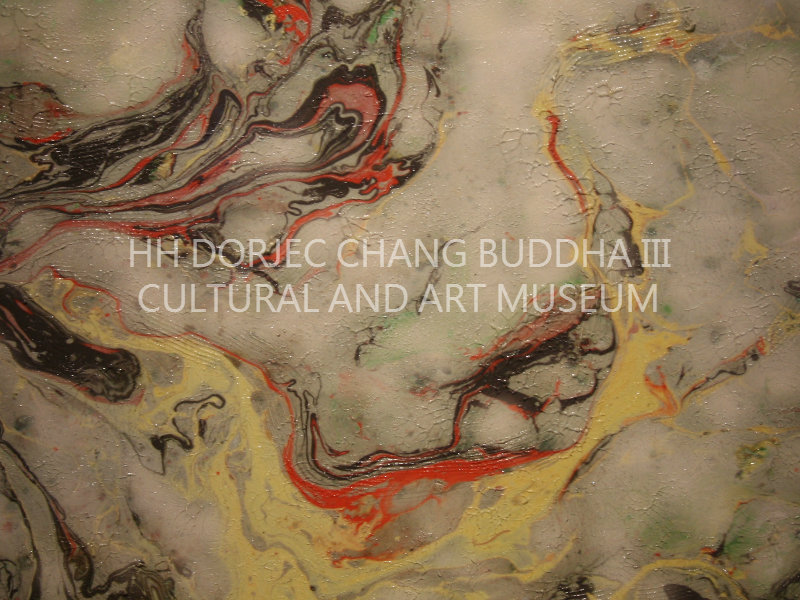
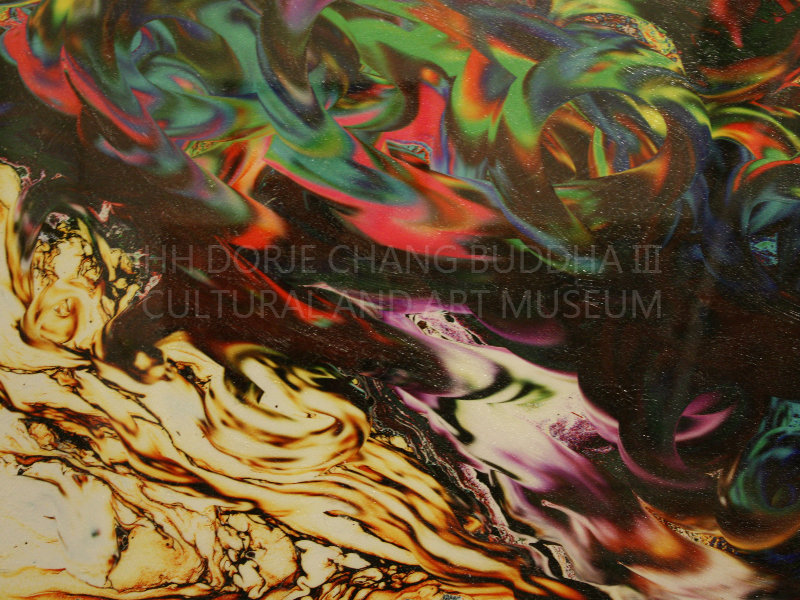
H.H. Dorje Chang Buddha III employs his 'supernatural abstract colors' to introduce us once more to a new world of art that is beautiful, mysterious, and soul-inspiring.
Hearing this, some may be puzzled: Western oil paintings are abstract paintings are found everywhere, yet which one among them ever fits the description "soul-inspiring"? But this truly is not just some fancy talk. As soon as you set your eyes onH.H. Dorje Chang Buddha III's "supernatural abstract colors," you will find the bright and dazzling red, yellow, blue, white and black colors leaping and dancing, vigorous like billows sluicing over thousands of miles, yet stored up into wonders at the fine tip of a brush. Gentle yet resolute, they freely transcend worldliness. Various colors are mixed ingeniously and beautifully, distilling beauty from their mutual nourishment. One could say they present a state of superb craftsmanship excelling nature, and of form becoming flexible and elusive. Words cannot describe such harmonious, refined, and soothing artistic enjoyment.
"Supernatural abstract color" is a perfect world composed of colors. It does not have any concrete worldly form but uses only colors to form shapes and express feelings. Color is its shape and theme, and it blends into touching charm. These colors, under the Buddha's hand, suddenly converge into unparalleled, marvelous and bright magic, expressing the vivid spirit of a flowery scene or the vigor of the roaring sea. Yet, they can be ever so exact when their meaning is revealed through the tip of a brush. Their fine details are often revealed among rough strokes, and their charm is naturally displayed.
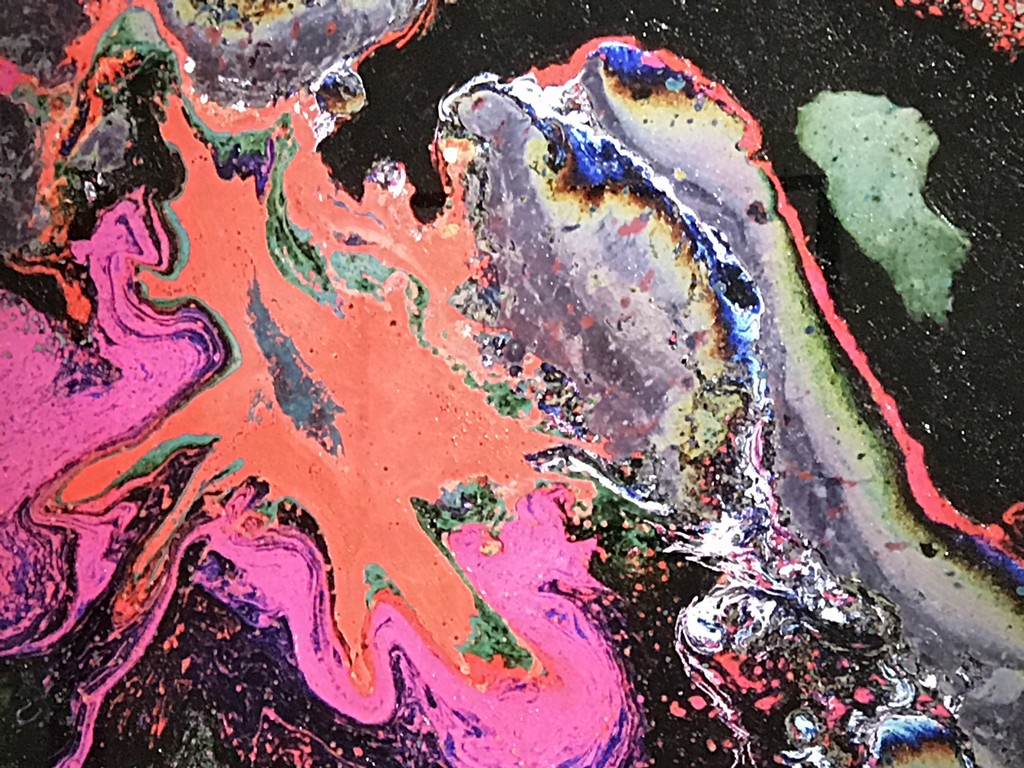
Microprint
Deng Chengjun Dianjian
Always remember the shock you felt when you first saw the "microprint" painting! !
The trembling gesture, Shenxiong's rhyme, and the emanating of the dynamic and magical color. In the strand of running, the pen and ink penetrated, and the brilliant Xia halo revealed a trace of meditation, shooting straight into the depths of the sky. Yamagawa, Yunhai, Twilight, and Xingli, under reprimand and traction each other, set out magnificent psalms, and I was deeply fascinated by the super drunkenness. Really! Everything is flashing endlessly.
H.H. The world of illusion under the colorful pen of the third world. It looks natural and better than natural, this ⁇ is not an empty talk. The essence of the whitening of the whitening is expressed in the spirituality of detail and rhyme, that is, the microscopic dynamic rhyme produced by unreal staggered errors such as filaments, air color, wetness, and lightness. Under the victory pen, the vitality cloth is still wet! ! Among them, the stone crashes, the light curtain light yarns, the strange ones are bluffed, the strange appearance is rock massifted, ⁇ Tingyu Atrium Nobuyoshi, the speed of the gods is galloping, and the redness is as long as the green flowers and the sunrise is long and empty. ⁇ watch frost, warm and nourishing. The rhyme is between the open and open drum sluts, and the reality of the mutual watch, such as the perturbation of the latent dragon, shows the magical beauty of the beautiful and unnamed. On the basis of the scene, the singularity is extinct, and the strange force is dusty. There are so many different wonders in the world. In terms of color variation, the magic is extinct, the splendidness is extremely popular, and the non-pen and ink can describe it; it is not verbally wordable, nor is it comparable to the dusty world, and it is even more within the reach of the world's all-round pen.
Phantom color in the microscopic
The microprinted one is called "Fully Moody", and we see that the entire picture is driven by the obscure cloud fog, showing a vast and boundless rhyme, overflowing the paper. Atmospheric flow layers composed of colorful colors such as cobalt blue, golden yellow, ⁇ red, and emerald, together, illuminate the entire starboard.
The magnificent under the pen of Buddha, the illusory appearance of the straight mash-sound sky, the whole painting is like smashing the earth of the mountain river, incorporating between the scales and the profit margin, the wonderful changes are beyond imagination and beyond the language. In the present, the person is drunk with color, the true color is hidden, the color is shown, and the color is broken. The positive path is out: the color is super unreal phenotype, which is real and natural!
In the picture, we can no longer find the visual alpine running water; under the magnificent composition and stunning colorless bottom, the joy hidden behind the mountains and running water is activated, and the species of art transcends everything in the world form. Every detail is fixed, and another layer of more profound and meticulous state can be seen. Xuanao is far from the bottom! Here you can see the Feiquan Falls on the Wanliyun Mountain; or Xu Mei will find the green ⁇ flowers in the ⁇ realm. From this, I feel that the washing soul is temporarily out of the world. At this moment, I forgot the time, forgot the shackles, forgot myself, and was at ease. This feeling transcends all the feelings and language in the world!
Divine change on the texture
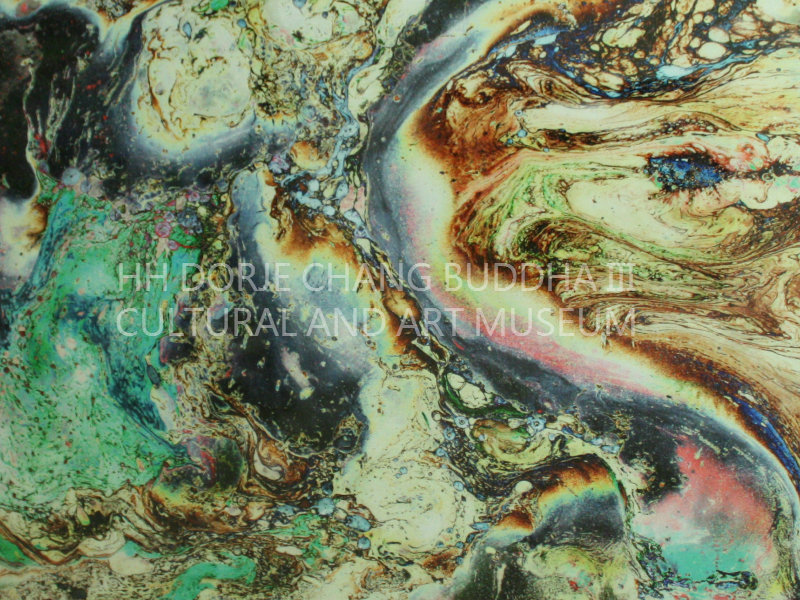
Another microprinted work "The Wonders of the Fantasy Island". The intricate colors in the center of the picture are under the black and white backing, the mutual table is unreal, and the interwoven layer of stacked three-dimensional fantasy space is greatly conceived. There are many seven-color bands directly above, which seem ordinary, but in fact it is never simple! The ribbon is cylindrical and has rainbow-like color changes. Each color is composed of blue turn blue, blue turn yellow, then red from yellow to red, and finally red to purple, with a sharp transition. Surprisingly, no traces of falling pens can be found in the transfer room of colors, and the delicate changes are made. But even more incredible is the use of the color transformation in the present, showing the different sizes of each ribbon, rough and young, far behind, fast and slow, forward angle and arc distortion. Every light seems to have life, it is breaking through the limits of space, living like a variety of colorful and phantom jaws are ⁇ , and will break out.
I am a painter of Hatsuka for many years of oil painting age, but I still can't think of a way to draw such an exquisite change! What's more, under multi-beam traction and handover, it is necessary to regularly draw a complex stereo space without deformation and confusion. It's really hard to reach heaven! In terms of taking ten thousand steps back, using today's computer software, it is difficult to calculate such a complex structure. This is why the art of Buddha cannot come to ⁇ and copy at all. I suddenly felt that it was not just a painting! !
Mustard Nasu
H.H. The mountainous land within the Third World's Dove (Buddha's Micropaginist) is like an incredible method, incorporated between the scale and the scale, and the divine realm transcends the general secular landscape. Therefore, whenever we look at a torrent or a starlight, we actually point to a landscape in our hearts at the same time. At this time, the heart evokes deep joy and awakening as the picture is towed. At this moment you may feel time and space, and there is a strong and unspeakable relationship between yourself and heaven and earth.
The works of the micro-prints are like a door that can open the mystery of the universe, can ⁇ Di soul, not only point to the endless sky, but also as an overture to open the truth in your heart. This is why Buddha's work transcends all art in the world!
It is true that what I said above is only my own superficial view, but I am convinced that as long as the purest heart is used to understand the joy in it, I will finally realize the sacredness of Buddha V.





Comments
Post a Comment