Kalash/Chitral
Poem in Exile
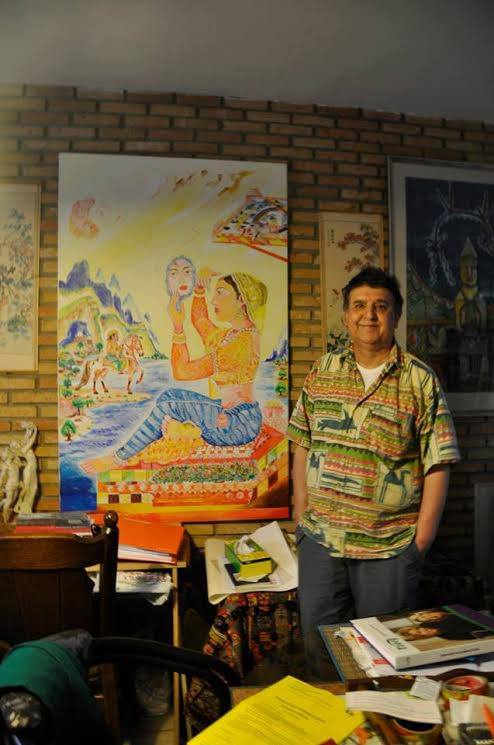
Poem By M.Bugi-in exile
Clasp Your Hands....in Forbearance,,,,
Crawl On The Floor,,,,,,Of Humbleness,,,,,
Pilgrimage in shape of TOLERANCE.
The Journey is spread till The HORIZON U Vagabond Hermit,
You are on Your Own Journey.
Like so many Journey's But this time is Point of NO RETURN...
Every few steps on Route to Enlightenment,,,,,,,,
Of the High Pasture,,,, Bow Your Aching Body,,
DO YOUR KO TAO'S', You have come for a divine Purpose,
Lets Pay.. Homage, Let me assure you, NOW,,,,
You the EARTHLING!...you have had Temptations,
To cross over,,,, no not yet, as you are Now,,,,
Not In The Forbidden CITY,
Here You Go Among vastness Of Praying Flags,,,,,
Fluttering as if the Horse and its wind Passes You Like a whisper.
Beware, The Devil even creeps in the praying Monks Midst,
You must make Noise .about your OWN Spirituality,,,,.
in shape of Loudly Clap Your Hands, And Pray,
while doing SO Keep Turning the Wooden Rosary,
I will Burn the Holy Juniper twigs, and Camphor,for the Journey,
With TREE GLUE,,
The square in The Monastery of Life,,,
A mandalla, made in The Colored Sand,
Only to Be destroyed and ashes sent to the Lake.
The Journey Begins The rest is Nowhere, to be seen.
From The Mountain springs, the waterfalls Drip tearing apart its Mightyness,
Time Keeps Flowing,for others to Notice, change your Shapes,
Bon Yoyage, Bon Voyage, as I Bid Farewell, is a mere Indication.
High upon the Mountains is a Sacred Temple....
The Third Eye Keeping an Eye on You,
With Ablutions of Tear drops of Heaven in Dew and Mist, of The clouds,,,,,
With In Curling Praying WHEELS, we are waiting for you Up there,,,,
, OH Lofty Mountains!!,,,, Grant This Pilgrim Safe Passage ....
Please Do Not Hinder his Journey on the sacred Rainbows,,,,
As he has suffered a LOT already,,,Covered with The Snow,,,,
are the Piles of Wishes,,Of the wish Full Thinking Jewel,,,,
BEHOLD me In Silence,,,,,
As i will Flatter In the Passing Wind, Observe me, I am a prayer flag,
Moving in the Winds Direction, I am Bringing to you News.....
NEWS from the horses that are Running along Your Markings of Devotion,
Like Thunder and Lightening, in Milky ways, announcing your Presence,,
your Journey to the other WORLD's unknown to Man,,,,
in My Prayer Flags, are embossed,
Solicitude to Eternity, for Peace that is everlasting,
Nothing will Bother you again,,,
In Your Psychedelic Apathy, of Bygone Age,,,,
M.Bugi,.........
(poems in Exile) at Breda, Holland.
Clasp Your Hands....in Forbearance,,,,
Crawl On The Floor,,,,,,Of Humbleness,,,,,
Pilgrimage in shape of TOLERANCE.
The Journey is spread till The HORIZON U Vagabond Hermit,
You are on Your Own Journey.
Like so many Journey's But this time is Point of NO RETURN...
Every few steps on Route to Enlightenment,,,,,,,,
Of the High Pasture,,,, Bow Your Aching Body,,
DO YOUR KO TAO'S', You have come for a divine Purpose,
Lets Pay.. Homage, Let me assure you, NOW,,,,
You the EARTHLING!...you have had Temptations,
To cross over,,,, no not yet, as you are Now,,,,
Not In The Forbidden CITY,
Here You Go Among vastness Of Praying Flags,,,,,
Fluttering as if the Horse and its wind Passes You Like a whisper.
Beware, The Devil even creeps in the praying Monks Midst,
You must make Noise .about your OWN Spirituality,,,,.
in shape of Loudly Clap Your Hands, And Pray,
while doing SO Keep Turning the Wooden Rosary,
I will Burn the Holy Juniper twigs, and Camphor,for the Journey,
With TREE GLUE,,
The square in The Monastery of Life,,,
A mandalla, made in The Colored Sand,
Only to Be destroyed and ashes sent to the Lake.
The Journey Begins The rest is Nowhere, to be seen.
From The Mountain springs, the waterfalls Drip tearing apart its Mightyness,
Time Keeps Flowing,for others to Notice, change your Shapes,
Bon Yoyage, Bon Voyage, as I Bid Farewell, is a mere Indication.
High upon the Mountains is a Sacred Temple....
The Third Eye Keeping an Eye on You,
With Ablutions of Tear drops of Heaven in Dew and Mist, of The clouds,,,,,
With In Curling Praying WHEELS, we are waiting for you Up there,,,,
, OH Lofty Mountains!!,,,, Grant This Pilgrim Safe Passage ....
Please Do Not Hinder his Journey on the sacred Rainbows,,,,
As he has suffered a LOT already,,,Covered with The Snow,,,,
are the Piles of Wishes,,Of the wish Full Thinking Jewel,,,,
BEHOLD me In Silence,,,,,
As i will Flatter In the Passing Wind, Observe me, I am a prayer flag,
Moving in the Winds Direction, I am Bringing to you News.....
NEWS from the horses that are Running along Your Markings of Devotion,
Like Thunder and Lightening, in Milky ways, announcing your Presence,,
your Journey to the other WORLD's unknown to Man,,,,
in My Prayer Flags, are embossed,
Solicitude to Eternity, for Peace that is everlasting,
Nothing will Bother you again,,,
In Your Psychedelic Apathy, of Bygone Age,,,,
M.Bugi,.........
(poems in Exile) at Breda, Holland.
A Little Boy Said to His Mother

Every picture tells its story.,
The leaves falling from the tree
Down into the same tree
Being reflected in the river.
If you can make fire out of wood, you can also make pictures, carve a wooden flame, make art. `And so, Bugi’s craft was born in being realised.
Throughout his formative years, Bugi introduced himself, and was introduced, thought books, to Oriental Minatures and Eastern Woodprints. Born and raised in Lahore, Bugi was surrounded by objects steeped in tradition. He grew interested in the Kalash; an indigenous minority peopleing part of North Pakistan and Afghastan. Their art forms enthralled me, their wood and rock carvings. These carvings were sculpted by shepards marking the route of the silk trade from China, eastwards. In woodcarvings I felt the roots of trees. Through wood I touched my forefathers, felt the tree in myself, wished to maintain tradition.’
When Bugi was nineteen he went to the Soviet culture center in Karachi, where he discovered books on the great western artists. Names such as Jeryonomous Den Bosch and Michael Angelo entered his vison literally and aesthically. In his own words, first came wood, then paint; that sort of evolution.’
For the next fifteen years, Bugi worked for advertising agencies, where he developed, through graphics, a modern perception of visual expression. Eventually, the trough was full. Overspill. Bugi quit. He wanted to travel, to touch, sniff and breath other cultures. He went round the world twice, touching its four corners. Although the world is round, the eye has a corner. During his travels, Bugi felt the imponderable. Light takes those corners away, he says, filling the broad room of his smile.
In China he met and worked under Li Shou Ping in Guilin. Li was a fine landscape painter, who made Bugi sit on the floor, thus introducing him to the first position of traditional Chinese painting. The hand is the body. The hand in the body. The big before the small. Bugi had learned something. It was time to move on, leave the floor of the mountain and sail towards the unknown.
He arrived in Cuba after spending three and a half months in Indonesia. One day while walking in Santiago, Bugi saw a portrait of Che Guervera Lynch through the bars of a painless window. Who is the artist? he enquired. Roberto Gonzalez, his sister replied. She gave Bugi her brother’s address. Next day Bugi was on a bus heading for Matenza, where he made contact with Roberto and his acolytes. After spending four months in Cuba, Bugi, continuing his journey, arrived in Panama.
By the banks of the canal, he studied the technique of raising and lowering water levels. `The Mathmathics Of Sluice. Water finds its own level, sometimes with man’s assistance. Water and paint on canvas are no different. The two merge, flow as one, inseperatebly surfacing in the cornerless eye, like the fish in the canal coming up to the flood lights along its bank, coming up to dud-suns, dieing stars.
In New York, Bugi attended the museum of Modern Art and rediscovered surrealism. The man and his madness. A wooden flame will not burn unless lit From New York he travelled to New Orleans, Cajun Pie; then onto Norfolk Virginia…. O country roads take me home…then onto Paris and a dream come true; the history of impressionism, its colour and light; the ivy in the ditch not green but blue, the alder tree not brown, but pink; seeing things though, the endless eye looking at the finite, no corner cutting.
Now living in the Netherlands, where he attended art Academy, Bugi had been somewhat dryly and rationally seen as a…… Culture Dog…. Barking….Bow Wow…
which is a long winded way of saying, Bugi is a craftsman, no fly by night gimmick-merchant, not out to impress something upon the eye but to engrain it in the memory. His themse is loss, loss of tradition, cultural upheaval, the Kalash being a prime example. In fact, Bugi’s theme is life, what is not left of it, what has yet to be, the here, the now. His sense of loss is also the exile in himself attempting to find unconcealment. Through his travels, his study, his roots, Bugi paints and shapes his own peice of ground,
far from home, to learn as Joyce says’ what the heart is and what it feels.`
Homage to Bashara Khan Kalash


Journey to Chitral
Mirza and Habibullah go to Chitral to talk to the D.C., get permission to enter Kalash and check on horse food. Ayesha and I spend hours looking for anything for the horses to eat in Drosh. We walk through the fields trying to locate where wheat has been threshed so we can get some boose. We comb the bazaars for flour, barley, anything! Never thought we'd be so happy to find a sack of barley. The flies in the barren lot behind the hotel where the horses are staked are loathsome. The stench of their old bread and barley shit is nauseating.
The next morning we leave Drosh. Horse's withers are bad. Coming down the Lowari Pass Shokot's withers have started developing the same type of hard lump that Horse started with. Mirza rides Hercules, Ayesha rides Kodak, Habibullah and I walk leading Horse and Shokot.
We stop at an animal husbandry hospital on the outskirts of Drosh to see what can be done for the horses. The dispenser washes their wounds with the same orange wash we've been using, powders them with the same white mixture and has a boy bring out a bottle of oxytetracycline. There is only one shot left in the bottle. The rubber seal has already been punctured, but he plunges the dark green fluid into Horse's neck.
The boy goes to the bazaar to bring more medicine. We have tea with the dispenser on the veranda. The liquid in the fresh bottle is a pale translucent amber color. He gives Shokot a shot. Mirza and Ayesha leave Drosh ponying Horse and Shokot. Habibullah and I remain to get supplies and hire a jeep to take us to Ayun. It's enjoyable doing business in the bazaar with Habibullah. He does the bulk of the talking. No one knows I'm foreign. Just a couple of simple Pathans from down country. It's nice not being the show for a change, just to relax in a part of it.
Habibullah and I hire a jeep to take us and the gear to Ayun. He will find another vehicle there, Insh'Allah, to take him on to Kafiristan. I plan to meet Mirza and Ayesha at the old suspension bridge that spans the river. We pass them on the road. An hour later I get off before where the bridge, built in 1927, crosses the muddy, rushing Kunar/Chitral River.
Beyond the bridge the road becomes dusty dirt on the west bank leading on to Ayun. It saves the distance of first riding to Chitral before backtracking to Ayun. Mirza had obtained our passes to enter Kafiristan when he went to Chitral with Habibullah. My job is to wait at the bridge to help them cross the four horses over. I sit on a grassy hillside overlooking the river with stream-lets of clear cool water gurgling through the short grass around me and tumbling down the rocky banks to join the swirling river. I smoke a cigarette and idly watch some grazing sheep.
Mirza, Ayesha and the horses arrive shortly after noon. Before crossing they join me on the grass for lunch—a can of sardines, crackers and water. Mirza wants to take pictures documenting our crossing of the suspension bridge but it is not to be. Before we can shoot anything a soldier comes up to us and tells us that it is illegal to photograph the bridge. He is an older fellow, approaching middle age and a potbelly, who could probably only be posted in such a useless post as guarding some stupid bridge (In all fairness we are right on the war sensitive Afghanistan border).
We show him our letters from Islamabad, first the English one to duly impress, then the Urdu one so he can read it. He's rude. He doesn't seem to be able to read Urdu very well though.
"We don't give a shit about your stupid bridge, anyway," I tell him. "We just want pictures of our horses crossing it. What importance can it have? It's an antique. That is why we want the pictures."
Mirza and I discuss shooting him but wisely decide just to head on. We still have a long, hot ride to Kafiristan and besides, bullets are costly.
After crossing the bridge I lead Horse. He is becoming lethargic and needs to be coaxed along. The bank of the river is rocky and 40 feet below us. The water is impossible to get to. In half an hour I decide to try to cadge a ride on the next jeep passing us to get into the valley of Kafiristan before the horses do, to make sure all arrangements are satisfactory.
Kafiristan (Kalash) is the home of the Kafir Kalash—primitive pagan tribes known as the Wearers of the Black Robes. Their origin is cloaked in controversy. Legend says that five soldiers from the legions of Alexander the Great settled there and are the progenitors of the Kalash.
They live in three valleys in small villages built on the hillsides near the banks of the Kalash River and its tiny tributaries in houses of rough hewn logs, double storied because of the steepness of the slopes. The lower portions are usually for animals and fodder storage for the long harsh winters. They practice a religion of nature worship. It is the only area in Pakistan or Afghanistan that hasn't been converted to Islam, though that is slowly changing with the times. Across the mountains in Afghanistan the Kafirs were converted in the 1890s by Amir Abdur Rahman, the 'Iron Amir' of Kabul, and Kafiristan (land of unbelievers) became Nuristan (land of light).
Fifteen minutes after walking on ahead of Mirza and Ayesha, a jeep passes. It slows for me and I climb in. On the front seat sit two men along with the driver. The older of them, with a bushy, brown, wavy beard and wearing a pakul cap, asks me if I have heard of Rambur Valley. He tells me he is the headman of the village of Rambur. I vaguely remember him, but to my good luck, he doesn't recognize me.
When he had last seen me two years ago I was speaking Farsi and English, not Pashtu. We had fought because I had defecated down by the river, which I hadn't known at the time was their Kafir 'holy place'. He had wanted me to wash in the river to rectify it but I wasn't going to bathe in that icy water. I had told him the hell with him and his foolish Kafir superstitions. I promptly left and walked the 10 miles back to Bumburet!
We drive past the Kafiristan turnoff, a steep dirt road leading up and west into the narrow valley of Kafiristan. The jeep stops short of Ayun and I walk the remaining distance. Habibullah isn't anywhere to be seen. I assume he has caught a jeep into Kafiristan and that everything will be prepared for our arrival.
I sit at a table set in the wide, dusty street with some chairs around it and a tattered canvas overhang to shield customers from the sun and drink mango sherbet with delightfully cold, dirty, shredded snow ice. Ayun is dead as it was on my last visit in 1987. It reminds me of a semi-deserted western ghost town. It is getting late in the day, almost 3:00 P.M., and there aren't even any jeeps waiting around to go to Kafiristan. Not feeling too patient, I decide to start walking the distance. If a jeep comes there is only one road and I'll be on it.
I head back down the road I had come into town on and make a sharp right turn up the dry, rocky, mountain pathway that leads to the Kafir valleys, winding back and forth up the mountain until I am high above the silvery Kalash River twisting through the valley below me on its way to join the Chitral River. At my feet is a steep incline of jumbled rocks tumbling chaotically down to green and golden fields of wheat nurtured on the life-giving crystal waters of the river, ripening in the warm summer winds. Good news, I think. Wheat is ripe and ready for the thresher. There will be boose available for the horses if we need it, though still I am dreaming of fields of tall green grass in Kafiristan.
At its highest section, the road precariously carves into the mountain side, leads through stone cliffs, rock completely overhanging the way. Virtually two miles of rock tunnel. I had been in this rocky tunnel two years before. Then I rode standing on the back bumper of a cargo jeep with two Pathan traders. We had to duck our heads in order to keep them from being chopped off by the sharp rocks overhead. The northern side of the road drops vertically straight off hundreds of feet down to the rushing Kalash River. High up on the opposite mountainside is what appears to be an even more precariously narrow road. In reality it is an aqueduct bringing water down to Ayun from higher up where the Kalash River comes out of Afghanistan.
The way is long and I speed up my pace. I want to arrive before the horses to make sure Habibullah has gotten it together. I don't mind walking, in fact, I rather like it as long as I'm not carrying anything. Presently I'm only carrying my pistol and its weight bumps against my hip but it's a feeling I've gotten used to. A nice reassuring feeling.
All the way into Kafiristan only two jeeps pass. One is full of tourists and they don't stop to pick me up. I must look too Pakistani. The other is completely piled with Pakistanis. They really know how to load a jeep in these parts. Two fellows are perched on the hood and a double layer of passengers hang off the rear bumper. I shout to them as they grind dust and gears past me, asking if there is any room, but obviously there isn't and they don't bother breaking their momentum for me.
It takes me three and a half hours to cover the distance between Ayun and Bumburet. I walk past the Pakistani government check post at Dobash. I imagine I seem too local for them to bother with me. Even Pakistanis from other parts of Pakistan need to get a permit from the D.C. in Chitral to come here. The same happened the last time I passed this way, though at that time I was covered under the guise of a turban. Afghan Mujahideen don't need any permit. I guess with my white Peshawari cap and pistol I look too Pathan to bother with. And everybody knows a Pathan's pistol is his permit. What is the point of my entry permit?
I chuckle to myself thinking of a story told me by Anwar Khan in Peshawar about a policeman who asked a notorious badmash to show him his pistol permit. The badmash drew his pistol and shot the policeman in the leg. "Do you want to see another page now?" he asked the stunned policeman.
The first hotel to appear as I walk into Bumburet is the Benazir Hotel where I had stayed my last time in the valley. Thirsty, I don't even mind paying eight rupees for a Shazan (four rupees at most in Peshawar). I know it is difficult to bring anything up here as it all has to come by jeep from Chitral. It's hard enough getting anything up to Chitral. The Shazan is ice cold, having been submerged in a metal basket with other soft drink bottles in the cold stream across the road from the hotel. Dusk is falling as I trudge on up the road. I pass a few more small hotels. At one there is a familiar face sitting at a table under the veranda directly off the road.
I sit down with a Pathan in his early 30s from Tangi whom we had met on top of the Lowari Pass who had lived many years in England. He is just finishing filling a cigarette. A pot of chai arrives as I ask him if he has any news of Habibullah. As we are drinking the tea the chowkidar from the government rest house comes down the road looking for me.
In Chitral Mirza had obtained permission from the D.C. to stay at the guest house in Bumburet, but there is a slight problem. The guest house is under repairs. There is no electricity (the upper end of Bumburet Valley has electricity supplied by a small water-powered generator built by some Swiss people), no running water, no bathroom... nothing! He says Habibullah left all of our gear there but has gone down to the Kalash Hotel to see about making some other kind of arrangements.
As we talk we hear the sound of the horses' bells like an audio mirage growing in the gloaming. A Kalashi boy comes running up the road heralding the approach of our little caravan. I see Mirza and Ayesha. The sun has just set. The air is calm, quiet, fresh. Nothing else is.
As they come up the road and into sight, sweat stained and worn out, the chowkidar is just finishing telling me the news of the guest house and of Habibullah. Just then Habibullah comes down the road. There is only one road running through Bumburet and the Kalash Hotel is further up the road, the guest house further still. After the guest house the rough dirt road becomes two trails, one leading south and up the mountain to the valley of Birir and the other following the Kalash River into Afghanistan.
We meet in confusion, all at once. Horse looks bad. Almost dead. He is covered in sweat, especially his head, neck and withers. His large eyes are closed and tears are staining his cheeks. Do horses cry? His legs are wobbling. He's barely able to walk. I can see that Mirza and Ayesha are exhausted from the long day's journey plus the mental and emotional strain of getting Horse this far. As we lead the horses up the road I explain to Mirza and Ayesha an English version of what the chowkidar has just completed telling me. At the same time Habibullah is telling me (in Pashtu, of course) what is happening with the Kalash Hotel.
He says there are two small rooms but he neglected to make any reservations because he was afraid to give them an advance on the rooms and find out we still wanted to camp out at the guest house. He still hasn't quite to come to terms with the fact that even though we are Americans, and therefore "infinitely rich" and seemingly spending so much money on a horse trip of no apparent value, we still count and watch our every rupee, which I'm sure to him seems to be miserly fastidiousness.
"I know that hotel," Mirza says. "I stayed there for a bit with my horse in 1983. There's a huge grassy field right in front of it. A good place to tie the horses."
"Noor Mohammada, selor Punjabian, samon sara, woose hotel la zee. Road banday ma ohleeda," Habibullah informs me.
"Habibullah says that four Punjabis are on the road with packs, going toward the hotel now," I tell the others.
Just then Horse collapses in the road. He won't get up. Mirza, who has been leading him hands me his lead rope. I pull and Mirza whips his behind with his crop. "Get up you bloody bugger! Get up!" he screams.
"Quit it you guys!" Ayesha yells, "Can't you see he can't go on any more."
Habibullah doesn't say anything. He obviously can't understand our actions and motives. He thought we should have taken the horses over the Lowari Pass in a truck. He just looked at me blankly when I explained to him that wasn't the point of the trip and besides, after Chitral there would be mountains and passes much worse than the Lowari. If they couldn't make it over the Lowari they'd never make it beyond Chitral.
"We've got to get him up," Mirza shouts, "or he'll die right here. He can't spend the night here in the road. The hotel is less then a mile away. We've got to get him there."
Finally Horse gets up and stumbles on.
"Noor Mohammada, zer makkhi lar shah. Haghwi Punjabian akhairi kambray ba akhlee, ou beir munga ba suh oku?" Habibullah tells me calmly in his low gravelly voice.
"Habibullah's right," I tell Mirza. "I'd better go ahead to the hotel quickly before those Punjabis get there and take the last two rooms. I'll take Herc."
I swing onto Hercules' massive back and head up the road. Behind me I can still hear the other horses' bells as our weary caravan struggles up the road in the rapidly darkening dusk. Hercules can sense the urgency of our flight and gallops up the road under me. We pass the four Punjabis and jump the small stream that crosses the path leading to the hotel.
The Kalash Hotel faces east, back down Bumburet Valley. The two-story, wooden building looks out over a large, semicircular grass field. The north side is bordered by the road, the south is ringed by a rock strewn ravine in which 30 feet below the Kalash River rushes noisily by. As I ride up to the hotel I can see some long haired tourists upstairs on the porch. I can smell the familiar sweet scent of charras in the air. Some Pakistanis and Kalashis standing around the front of the hotel watch in surprise as I gallop up. I dismount and quickly tie Hercules to one of the poles holding up the porch.
A short man approaches me followed by two others. He's wearing a Nuristani (pakul) cap over his greasy black hair that hangs down behind his ears grimy with dirt. His pocked complexion also has an unwashed pallor and he looks at me through close-set, small, piercing black eyes.
Abdul Khaliq is the proprietor of the Kalash Hotel. I explain our situation to him. By the time we hear the horse bells approaching the hotel hasty preparations have been made. Several fellows go off to cut and fetch fresh, green cornstalks for the horses' dinner. The sound of the bells waxes louder and our footsore little caravan appears in the approaching night.
"What's happening, Noor?" Mirza asks me wearily.
"Look, come, we'll unload the horses here in front of the hotel. Then we can stake them over there." I point with my hand in the darkness to the edge of the field bordering the river ravine. "I've already arranged for some men to bring down fresh green cornstalks from the fields."
As we talk I am still finalizing arrangements with the hotel's jeep driver to drive Habibullah up to the guest house to get the rest of our gear. We leave the other three horses tied to the porch supports and take Horse down to the field under a tree. He collapses and is breathing very hard, lying flat on the short turf. After a time he lifts his head and then rises to urinate. Mirza walks him around. His abdomen is completely swollen. He alternately lies, rolls and gets up on wobbly legs. When he rises Mirza walks him gently until he falls again. We cover him with our blankets.
Ayesha and I unload the other horses in the light of the bare light bulbs hanging on the porch. Habibullah I send off in the jeep to collect our gear. We need the moogays to stake the horses securely for the night, plus we want the animal tranquilizers for Horse.
At a quarter to midnight I'm squatting outside the cookhouse talking and smoking with the cook. He's an Afghan from up the valley in Nuristan. Ayesha and Habibullah are asleep in their respective rooms. Mirza is lying in the field next to Horse, propped up by his saddle and covered with a blanket. I hear him call out to me. I go down and join him next to Horse.
"Horse just had some really bad convulsions," he says.
"Do you think he'll make it?" I ask.
"I don't know Noor. God, I wish now that I knew more about horse medicine. This is all my fault for not knowing more. I brought Horse into this and I don't know enough to get him out."
"It's nobody's fault. These things happen. It is the way God wills it."
Horse gets up and we gently lead him as he walks himself. Then he starts to topple again. He's falling against Herc and Herc can't get away because he's at the end of the rope he is staked to.
"Pull him Noor!" Mirza says hurriedly, pushing him with his shoulder to try to keep him from crashing against Herc. Mirza pulls out the razor sharp knife he wears on a sheath around his neck and with one quick sweep slices through the thick rope, freeing Hercules. Horse hits the grass. He's lying on his side and kicking violently. The cook comes down and squats beside us.
"You should cut a hole in his stomach to let the air out," he tells me in Pashtu. I translate this grisly information to Mirza.
"I've never heard of that," he tells me. "I'm afraid it will kill him. I still think he can make it if he can just make it through the night."
Horse stops kicking and holds his head back stiffly. Low, raspy breaths come from deep down in his throat. It's his death rattle.
"Cut his throat now," the cook tells me. "Halal him, and then at least the Muslim people up the hill can eat him."
I tell Mirza what the cook has said but he can't hear. We both feel that some miracle will pull him through and he'll be recovering in the morning. But it is not to be. It's too late. He's dead.
HE'S DEAD
"He's dead," Mirza said in English.
"He's dead," the cook and I echoed in Pashtu.
"I can't believe he's dead," Mirza said, dazed.
"You should have halaled him," the cook went on, "then the Muslim people could have eaten him. Well, no matter, it's not a waste. The Kafir people don't care about halal, the eaters of filth. They will eat him anyway."
That I didn't bother to translate.
We covered Horse with our plastic tarp and a rain poncho. A beautiful, silvery full moon was rising over the mountains heralded by a pearly glow rimming the hill tops. A few silver-lined clouds highlighted the star-studded sky. The moon and starlight reflected diamonds in the ripples of the stream as it splashed over white stones below us down the moss-covered rock-strewn river banks. Horse's body was laying on the greensward, half-a-ton of lifeless, stiffening meat. Life had fled him as the sun had fled the day's sky. The night was still, quiet and peaceful. It was seven minutes after midnight. Mirza and I watched the silent moon rising, neither speaking....
After a time we went upstairs and quietly entered Ayesha's room. She was asleep, exhausted on a charpoy, still in her travel-stained clothing. On the other charpoy our equipment was piled. On top our rifles and Ayesha's pistol and turban lay perched. At first she couldn't believe, or wouldn't comprehend, that Horse had died. Then she began to softly weep.
I left them alone in the room with their sadness shared and sat at the table on the porch alone in the night and filled a cigarette. As I smoked I looked down on the moonlight bathed field. Over by the tree near the edge of the ravine was the covered lump that had been Horse. Wrapped in my blanket, I gazed at the crystal bright moon in the sky, shivered and thought of sitting on a charpoy cozily with Nasreen on a warm night in Lahore (sweating).
Mirza and Ayesha emerged from the room and we went down to the field so she could see Horse. She petted his soft, cold nose. Only the wind in the leaves and the crickets spoke in the velvet mountain night. The three of us went back to the porch and sat silently at the table until 3:00 A.M., each in our own private thoughts. I went to my room, an eight by eight cubical with the floor covered with colorful quilts, to get a bit of sleep. No need to wake Habibullah I reasoned. He could wait until morning for the bad news.
At 5:30 I awoke and went outside. Horse was still laying there, an olive green covered mass on the emerald dewdrop sparkling grass.
His body was completely bloated. Last night had really happened. I hadn't dreamt it.
The other horses were standing oblivious in the quiet morning air. Mirza and I had moved them in the night to the other side of the field. They didn't seem to notice their dead companion as they calmly munched corn stalks. As I stood quietly looking at the pile of cold stiffening meat that was our traveling companion the hotel owner, Abdul Khaliq, came and stood beside me.
"So sorry about your horse," he said shallowly.
"Yeah, so are we," I said, already taking a dislike to the shifty little man. "God knows better."
"What do you want to do?" he started in. "We can't leave him here. It's not good for the hotel. And the local people are superstitious about such things. Yes, we must do something about him right away."
Already some local children were gathering around looking.
"We can get some men and a jeep to haul him away and bury him in the mountains," Abdul Khaliq continued.
"What's going on Noor?" Mirza asked as he joined us sleepily by Horse's side, his blue turban wrapped haphazardly around his head.
"Well, Abdul Khaliq here says he can get a jeep and some men to haul Horse away and bury him in the mountains," I informed him. "We can't leave him here."
"Yeah, we must bury him," he agreed. Turning to Abdul Khaliq he asked, "How much will it cost?"
Abdul Khaliq thought for a moment. He squinted and scanned us with his crafty eyes. "The jeep will be 1000 rupees. And then we must give the men each something for their work."
"You can't get a jeep for less then that?" I asked. It seemed rather dear.
"I don't think so, my brothers. We can't bury him near here. He will have to be taken a long way up into the hills."
"God's blood, it does seem expensive," Mirza said. "But he was our mate. We brought him all the way here to die. We have to bury him."
By now Habibullah and Ayesha had joined our grim little circle and I explained what was happening to Habibullah in Pashtu while Mirza explained to Ayesha in English. Abdul Khaliq stood by and looked at Horse, grinning. Ayesha agreed that the expensive price no matter, Horse must be buried at all costs, what else was there to do? After the events of the previous day we were all in a state of slightly shocked stupor to say the least. Habibullah just stood there silently as I told him. He understood enough to know that, as it wasn't his money what he thought was of no real consequence anyway.
"Okay. I will go see about arranging the jeep," Abdul Khaliq said as he walked off still grinning.
"Hagha mor ghod Kafir, ohgura. War-rawan day po ohkhanday, dah da hagha mor kus ohghaim. Sta po makh banday ghool okama, banchoda!" Habibullah said under his breath.
"What was that, Habibullah?" Ayesha asked.
"Oh, he said," I took the liberty of answering for him, "Look at that no good Kafir. He's smiling as he walks away!"
"Are you sure that's all he said, Noor Mohammad?" she asked, having picked up quite a smattering of Pashtu herself. "I thought I heard some other words I recognized. I think I heard some of them when you were speaking with the truck drivers." she teased.
"Ayesha, my dear, do you doubt my linguistic abilities? Sister, I speak truth! Now let's go back to the hotel and have some breakfast."
We sat at the table on the porch outside our rooms and ate in silence a breakfast of chai, greasy parattas and greasier fried eggs. None of us could think any further into the trip than the present: what should be done with the lifeless carcass of Horse and what to do with the three remaining horses that morning? As we ate, Abdul Khaliq came up on the porch and stood by the table. "I can't arrange a jeep," he started in suspiciously.
"What do you mean?" Mirza jumped in. "We have to do something about our horse."
"Yes, for sure, brother. But my jeep is gone and there isn't another available just now." He hesitated briefly and with a badly hidden grin on his face he continued, "Look, my friends, here is the only solution for you. We need to do something quickly, yes? I can get some men who can cut him into pieces. Then they can carry the pieces up to the mountains in baskets and bury him. It's the only way I can arrange."
Ayesha naturally freaked at the idea of cutting up Horse. Mirza and I looked at each other in bewilderment. Habibullah sat and went on drinking his tea as we were talking in English and he hadn't understood a word of what was going on.
"Look, Abdul Khaliq," Mirza said, "let us discuss this among ourselves. Then we will tell you."
"Okay, talk friends, but decide. We must do something quickly," he said, leaving us alone on the porch.
As we were all in an emotional and physical state of shock we decided there wasn't really anything else we could do. We were stuck in Kafiristan and our horse lay dead on Abdul Khaliq's lawn. The greedy Kafir, Abdul Khaliq, played on the emotional attachment he knew Westerners have for animals. Had we been Pathan we would have just said, "So what, he's dead in your field, Kafir. It's your problem now."
We decided Habibullah and Ayesha would take the horses across the road and up the hill to a rock wall corral to bathe them. Lord knows they needed it; they hadn't had a good washing since down country—and we didn't want them to witness what was going to happen to their dead companion, Horse, though in afterthought I think it was more to satisfy us than any of the horses' needs. For sure we didn't want Ayesha there to witness the macabre scene that would be unfolding in Abdul Khaliq's field.
Five men arrived with baskets, axes and large butcher knives. They wanted to chop him up down by the river where there was water available, plus out of sight of the inhabitants of the hotel. Too heavy for them alone, Mirza, Habibullah, Abdul Khaliq and I helped drag his stiff, lifeless form to the edge of the ravine. We rolled him over the edge and his big, bloated body rolled and crashed down on the rocks of the river bank below. We heard the sickening crunch of the bones in his legs snapping. Just a heavy, cold piece of spoiling meat now, though just yesterday he had been Horse. Well, that's life... and death. One day we all become just dead meat, don't we?
They took out their knives to skin him. They were only visible if you stood on the side of the ravine and looked down but the thudding blows of their axes could be heard in the hotel, the cold thuds of butchers chopping through meat, gristle and bone. Mirza and I walked down the road to look for grass to buy to feed the remaining horses. Or maybe a field of green grass to rent? Before we left I walked over to the edge of the ravine to see the butchers' progress. Just as I arrived at the edge they were chopping off Horse's head. Big, beautiful Horse, his large, sweet eyes. Now just meat. Rather grotesque but we are so far away from the world we had come from.
As we walked down the road a 'hippyish' looking moustached fellow with longish hair approached us. He was a Pakistani artist from Lahore. We introduced ourselves and had a bit of a chat. Even though Mohammad Bugi is a Muslim, from Lahore, he has been working wholeheartedly on preserving the Kalash arts and culture. He was in the process of putting on the first art workshop and show in the long history of Kalash. He had seen us riding in yesterday. He told us of the Frontier Hotel just down the road. It was run by a Muslim and there was room for us. We wanted to get away from the Kalash Hotel and its Kafir owner Abdul Khaliq. We wanted to forget what had happened there.
When we went back to the Kalash Hotel to fetch our little caravan Horse's white skin was laying stretched out on the ground next to the rivulet by the path leading to the hotel (not a good omen).
Now I'm sitting on the porch of the Frontier Hotel. The horses are with Habibullah grazing in a field of grass behind the hotel. The field isn't completely horizontal but it should keep the horses in green grass for at least a week. The hotel proprietor, Shukar Ali, helped us negotiate with a Kafir farmer, Ditullah Khan. It was confusing, the languages flying, but accomplished in the end. Ditullah Khan talking to Shukar Ali in Kalashi, Mirza talking to me in English and Shukar Ali and I bringing it together in Pashtu.
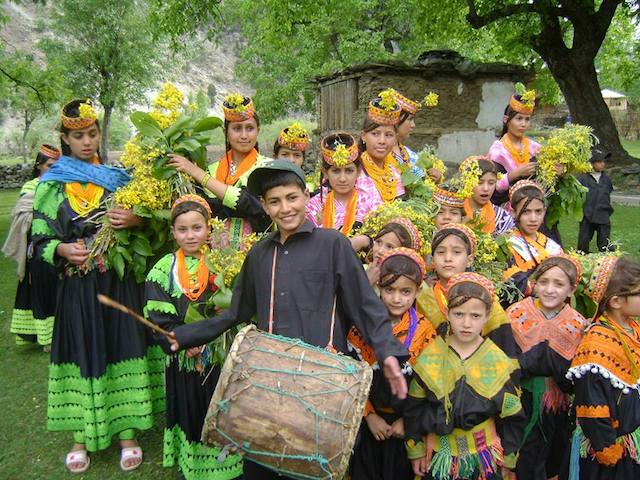
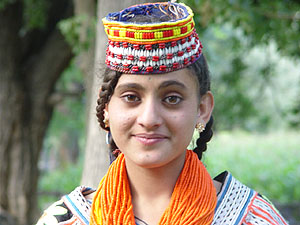
Ditullah Khan and his wife are Kafir. Kafir men wear the same clothes as Muslim men; usually shalwar kameez, waistcoat and woolen pakul caps, though their women dress differently than their Muslim sisters. They wear black, coarse cotton, ankle-length dresses with red, orange and yellow embroidery and caps with similarly-styled embroidery plus a mixture of red and bright phosphorescent colored plastic beads, cowrie shells and coins. They never go veiled. They also wear a profusion of red bead and cowrie shelled necklaces. Many make a paste of burnt goat horn (called Puru) and decorate their faces with black dots and patterns. It appears to be made from mud.
Ditullah Khan's daughter, about 17, also confuses me. She dresses in Muslim clothing but Shukar Ali tells me it isn't unusual in Kafiristan for individual family members to become Muslim, thus making Kafirs and Muslims in the same family. Also some girls choose to become Muslim in order to avoid the obnoxious attentions of Pakistani men tourists, who credit the Kafir women with a very loose reputation (though I find many Pakistani men think that about any woman who is not veiled or in the house).
As I sit here and write, Ditullah Khan's daughter is sitting on the hillside opposite the porch watching me. She smiles coyly every time I look her way. Is she just curious and friendly or is she making eyes at me? Are the Pakistani stories true or have I just become too Pakistani to be able to rightly judge anymore?
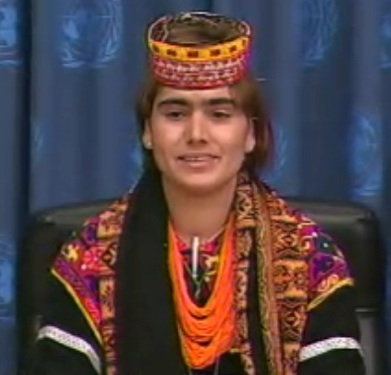
Oh the Blessed Kalash
You live with the beauty of God
The forest, mountains, and streams
A civilization unique and ancient
Rooted in history
If anything sustain you
Through your doubts
Existence of civilized trespassing
It's your conviction and belief
A holy bond with nature
Oh the blessed Kalash
I have seen the world
I have met the people
The world has changed
The beings become materialistic
The emotions got no value
Their feelings demise
The thing which remained with you
A heart of Gold and a diamond
A soft kind and honest
The treasure of feelings and care
Oh the blessed Kalash
21st century promises love peace
Liberty and freedom for all
Let's pray and wish this to be a true.
Hold onto your traditions
Everlasting and ethereal
Oh the Blessed Kalash
A Prayer from your daughter
Lakshan Bibi Kalash
Kafiristan
June 20th
'Rest day' in Drosh.
Misra and Habibullah go to Chitral to talk to the D.C., to get permission to enter Kalash, and to check on horse food. Ayesha and I spend hours looking for food for the horses in Drosh. We walk though the fields trying to find some wheat that has been threshed so we can get some boose (straw). Combing the bazaars for flour, barley, anything. Never thought we'd be so happy as to find a sack of barley. The flies in the barren lot behind the hotel the boys are staked out in are loathsome. The stench of their old bread and barley shit is nauseating.
The next morning we leave Drosh. Horse's withers are bad, and coming down the Lowry Pass Shokot's withers have started developing the same type of hard lump that Horse started with.
Misra rides Hercules and Ayesha rides Kodak. Habibullah and I walk leading Horse and Shokot. We stop at an animal husbandry hospital on the outskirts of Drosh to see what can be done for them. The dispenser washes their wounds with the same orange wash we are using. Then he powders them with the white powder. He has a boy bring out a bottle of oxi-tetracycline. There is only one shot left in the bottle, the rubber seal has already been punctured, and he plunges the dark green fluid into Horse's neck.
The boy goes to the bazaar to bring some more. We have tea with the dispenser on the veranda. The liquid in the fresh bottle is a pale amber color. He gives Shokot a shot. Misra and Ayesha leave Drosh ponying Horse and Shokot. Habibullah and I remain to get supplies and hire a jeep to Ayun. It's enjoyable doing business in the bazaar with Habibullah. Habibullah does the bulk of the talking. No one knows I'm foreign. Just a couple of simple Pathans from down country. It's nice not being the show for a change, just a part of it.
Habibullah and I hire a jeep to take us and the gear to Ayun. Habib will find another jeep there, insh'Allah to take him on to Kafiristan. I plan to meet Misra and Ayesha at the old suspension bridge spanning the river. We pass them on the road. An hour later I get off before where the bridge, built in 1927, crosses the muddy rushing Chitral River. Beyond the bridge the road becomes dusty dirt, on the west bank of the river, on to Ayun. It saves the distance of first riding to Chitral before back tracking to Ayun. Misra has already obtained our passes to enter Kafiristan when he had gone to Chitral with Habibullah. My job is to wait at the bridge for them to help them cross the four horses over.
I sit on a grassy hill side overlooking the river with streamlets of clear cool water gurgling through the short grass and tumbling down the rocky banks to join the swirling river. I smoke a cigarette and idly watch some grazing sheep.
Misra, Ayesha, and the horses arrive shortly after noon. Before crossing they join me on the grass for lunch. A can of sardines, crackers and water. Asadullah wants to take pictures documenting our crossing of the suspension bridge but it is not to be. Before we can shoot anything a soldier comes up to us and tells us that it is illegal to photograph the bridge. He is an older soldier, approaching middle age and a potbelly, who could probably only be posted in such a useless post as guarding some stupid bridge (in all fairness we were right on the war sensitive Afghanistan border).
We show him our letters from Islamabad, first the English one to duly impress, then the Urdu one so he can read it. He's rude. He can't read Urdu very well anyway.
"We don't give a shit about your stupid bridge, anyway." I tell him. "We just want pictures of our horses crossing it. What importance can it have? It's an antique. That is why we want the pictures."
Misra and I discuss shooting him, but wisely decide just to head on. We still have a long hot ride to Kafiristan, and besides, bullets are costly.
After crossing the bridge I walk along with them leading Horse. He is becoming lethargic and needs to be coaxed along. The bank of the river is rocky and forty feet below us. The water is impossible to get to. In half an hour I decide to try to catch a ride on the next jeep passing us, to get into the valley of Kafiristan before the horses and to make sure all arrangements are satisfactory.
Kafiristan is the home of the Kafir Kalash - primitive pagan tribes, known as the wearers of the black robes. Their origin is cloaked in controversy. Legend says that five soldiers from the legions of Alexander the Great settled there and are the progenitors of the Kalash. They live in three valleys in small villages built on the hill sides near the banks of the Kalash River, and it's tiny tributaries, in houses of rough hewn logs, doubled storied because of the steepness of the slopes. The lower portions are usually for animals and fodder storage for the long harsh winters. They practice a religion of worship of nature. It is the only area in Pakistan-Afghanistan that hasn't been converted to Islam, though that is slowly changing with the times. Across the mountains, in Afghanistan, the Kalash were converted in the 1890's by Amir Abdur Rahman, the iron amir of Kabul, and Kafiristan became Nuristan.
Fifteen minutes after walking on ahead of Misra and Ayesha a jeep passes. I climb in. On the front seat are two fellows along with the driver. The older of the two, with a bushy brown wavy beard and wearing a pakul cap, asks me if I have heard of Rambur Valley. He tells me he is the headman of the village of Rambur. I vaguely remember him but to my good luck he doesn't recognize me. When he last saw me, two years ago, I was speaking Farsi and English, not Pashtu. We had fought because I had defecated down by the river, which I hadn't known at the time, was their Kafir holy place. He had wanted me to wash in the river to rectify it but I wasn't going to bathe in that icy cold water. I told him the hell with him and his foolish Kafir superstitions. I promptly left and walked the ten miles back to Bumburet.
We drive past the Kafiristan turnoff, a steep dirt road leading up and west, leading into the narrow valley of Kafiristan. The jeep stops short of Ayun and I walk the remaining distance. Habibullah isn't anywhere to be seen. I assume he has gotten a jeep into Kafiristan and that everything will be prepared for our arrival.
I sit at a table set up in the wide dusty street with some chairs around it and a tattered canvas overhang overhead to shield customers from the sun and drink a mango sherbat with delightfully cold dirty shredded snow ice. Ayun is dead, as usual. It always reminds me of a semi-deserted western ghost town. It is getting late in the day, almost 3 P.M., and there aren't even any jeeps waiting around to go to Kafiristan. I decide to start walking the distance. I can't sit and if a jeep does come through there is only one road. And I'll be on it.
I head back down the road I had come into town on. I make the sharp right turn up the dry rocky mountain leading to the Kafir valley. Winding back and forth up the mountain until I am high above the silvery Kalash River winding and twisting through the valley below me on it's way to join the Chitral River. At my feet a steep incline of jumbled rocks, tumbling chaotically down to green and golden fields of wheat, nurtured on the life giving waters of the river and ripening in the warm summer winds.
Good news, I think. Wheat is ripe and ready for the thresher. There will be boose available for the horses if we need it, though still I am dreaming of fields of tall green grass in Kafiristan. At the highest section of the road it leads through rock cliffs, the road precariously carved into the mountainside, rocks completely overhanging the road. Virtually two miles of rock tunnel. I had been in this rocky tunnel before two years ago. Then I rode standing on the back bumper of a cargo jeep with two Pathan traders. We had to duck our heads in order to keep them from being chopped off by the sharp rocks overhead.
The northern side of the road drops vertically straight off and down to the rushing Kalash River. High up on the opposite mountain side is what appears to be an even more precariously narrow rock road. In reality it is an aqueduct bringing water from higher up, where the Kalash River comes out of Afghanistan, down to Ayun.
The way is long and I speed up my pace. I want to arrive before the horses to make sure Habibullah has gotten it together. I don't mind walking, in fact I rather like it, as long as I'm not carrying anything. Now I'm only carrying my pistol and its weight bumps against my hip but it's a weight I've gotten used to. A reassuring feel.
All the way into Kafiristan only two jeeps have passed me. One is full of tourists and they don't pick me up. I look too Pakistani. The other jeep that comes by is completely piled with Pakistanis'. They really know how to load a jeep in these parts. Two fellows are sitting perched on the hood and a double layer of them hanging off the rear bumper. I shout to them as they grind dust and gears past me if there is any room, but obviously there isn't and they don't bother breaking their momentum for me.
It takes me three and a half hours to cover the distance between Ayun and Bumburet. I walk past the Pakistani government check post. I imagine my vibe is too local for them to bother with me (even Pakistanis' from other parts of Pakistan need a permit from the D.C. in Chitral). The same happened the last time I passed this way, though at that time I was covered under the guise of a turban. Afghan Mujahideen don't need any permit. I guess with my white Peshawari cap and pistol I look too Pathan to bother with. And everybody knows a Pathan's pistol is his permit. What is the point of my entry permit?
I chuckle to myself thinking of a story told me by Anwar Khan about a policeman who asked a notorious badmash to show him his pistol permit. The badmash drew his pistol and shot the policeman in the leg. "Do you want to see another page now?" he asked the stunned policeman.
The first hotel to appear as I walk into Bumburet is the Benazir Hotel, where I had stayed my last time in the valley. Thirsty. I don't even mind paying eight rupees for a Shazan (four rupees at most in Peshawar). I know it is difficult to get anything up here. It all has to come by jeep from Chitral. It's hard enough getting anything up to Chitral. It's ice cold, having been submerged in a metal basket with other soft drink bottles in the icy stream running across the road from the hotel. Dusk is falling as I trudge on up the road. I pass a few more hotels. At one there is a familiar face sitting at a table under the veranda, directly off the road.
I sit down with Irfan, a Pathan in his early thirties from Tangi whom we had met on top of the Lowry Pass. He had lived many years in England. He is just finishing filling a cigarette. A pot of chai arrives as I ask him if he has any news of Habibullah. As we are drinking the tea the chowkidar from the government rest house comes down the road looking for me.
In Chitral Misra had gotten permission from the D.C. to stay at the guest house in Bumburet, but there is a slight problem. The guest house is under repairs. There is no electricity (the upper end of Bumburet Valley has electricity supplied by a small water powered generator built by some Swiss people), no running water, no bathroom . . . nothing. He says Habibullah has left all of our gear there, but has gone down to the Kalash Hotel to see about making some kind of other arrangements.
As we talk, we hear the sound of the horse's bells like an audio mirage growing in the gloaming. A Kalashi boy comes running up the road heralding the approach of our little caravan. I see Misra and Ayesha. The sun has just set. The air is calm, quiet, fresh. Nothing else is. As they come up the road and into sight, sweat stained and worn out, the chowkidar is just finishing telling me the news of the guest house and of Habibullah. Just then Habibullah comes down the road. There is only one road running through Bumburet and the Kalash hotel is further up the road, the guest house further up still. After the guest house the rough dirt road becomes two trails, one leading south and up the mountain to the valley of Birir, and the other leading past the guest house following the Kalash River into Afghanistan.
We meet in confusion, all at once. Horse looks bad. Almost dead. He is covered in sweat, especially his head, neck, and withers. His large eyes are closed and tears are staining his cheeks. His legs are shaking and wobbling. He seems barely able to walk. I can see that Misra and Ayesha are exhausted from the long day's journey plus the mental and emotional strain of getting Horse this far. As we lead the horses up the road I explain to them an English version of what the chowkidar has just completed telling me. At the same time Habibullah is telling me (in Pashtu, of course) what is happening with the Kalash Hotel.
He says there are two small rooms but he neglected to make any reservations because he was afraid to give them an advance on the rooms and find out we still wanted to camp out at the guest house. He still isn't quite able to come to terms with the fact that even though we are Americans, and therefore infinitely rich, and seemingly spending so much money on a horse trip of no apparent value, we still count and watch our every rupee, which I'm sure to him seems as miserly fastidiousness.
"I know that hotel," Misra says. "I stayed there for a bit with my horse in 1983. There's a huge grassy field right in front of it. A good place to tie the horses."
"Noor Mohammada, selor Punjabian, samon sara, woose hotel la zee. Road banday ma ohleeda." Habibullah informs me.
"Habibullah says that four Punjabis' are on the road, with packs, going toward the hotel now." I tell the others.
Just then Horse collapses in the road. He won't get up. Misra, who has been leading him hands me his lead rope. I pull and Misra whips his behind with his crop.
"Get up you bloody bugger!" he screams.
"Quit it you guys. Can't you see he can't go on any more." Ayesha yells.
Habibullah doesn't say anything. He obviously can't understand our actions and motives. He thought we should have taken the horses over the Lowry Pass in a truck. He just looked at me blankly when I explained to him that wasn't the point of the trip, and besides, after Chitral there would be mountains and passes much worse than the Lowry, if they couldn't make it over the Lowry, they'd never make it beyond Chitral.
"We've got to get him up," Misra shouts, "or he'll die right here. He can't spend the night here in the road. The hotel is less then a mile away. We've got to get him there." Finally he gets up and stumbles on.
"Noor Mohammada, zer makkhi lar shah. Haghwi Punjabi banchodan akhairi kambray ba akhlee, ou beir mung ba suh ohku?" Habibullah tells me calmly in his low gravelly voice.
"Habibullah's right." I tell Misra. "I better go ahead to the hotel quickly, before those Punjabis' get there and take the last two rooms. I'll take Herc."
I swing onto Hercules' massive back and head up the road. Behind me I can still hear the horse's bells as our weary caravan struggles up the road in the rapidly darkening dusk. Hercules can sense the urgency of our flight and gallops up the road under me. We pass the four Punjabis' and jump the small stream that crosses the path leading to the hotel.
The Kalash Hotel faces east, back down Bumburet Valley. The two story wooden building looks out over a large, semicircular grass field. The north side is bordered by the road, the south side is ringed by a rock strewn ravine, in which thirty feet below the Kalash River rushes noisily by. As I ride up to the hotel I can see some long-haired tourists upstairs on the porch. I can smell the familiar sweet smell of charras in the air. Some Pakistanis' and Kalashis' standing around the front of the hotel look up in surprise as I gallop up. I dismount and quickly tie Hercules to one of the poles holding up the porch.
A short man approaches me, followed by two others. He's wearing a Nuristani (pakul) cap over his greasy black hair hanging down behind his ears grimy with dirt. His pocked complexion also has a greasy unwashed pallor and he looks at me through close set small piercing black eyes. Abdul Khaliq is the proprietor of the Kalash Hotel. I explain our situation to him. By the time we hear the horse bells approaching the hotel hasty arrangements have been made. Several fellows go off to cut and fetch fresh green corn stalks for the horses' dinner. The sound of the bells waxes louder and our weary little caravan appears in the darkening night.
"What's happening, Noor?" Misra asks me wearily.
"Look, come, we'll unload the horses here, in front of the hotel. Then we can stake them over there." I point with my hand in the darkness to the edge of the field bordering the river ravine. "I've already arranged for some men to bring down some fresh green corn stalks from the fields."
As we talk, I am still finalizing arrangements with the hotel's jeep driver to drive Habibullah up to the guest house to get the rest of our gear. We leave the other three horses tied to the porch supports and take Horse down to the field under a tree. He collapses and is breathing very hard, laying flat on the field. After a time he lifts his head, and then rises to urinate. Misra walks him around. He abdomen is completely swollen. He alternately lies, rolls, and gets up on wobbly legs. When he rises Misra walks him gently until he collapses again. We cover him with some of our blankets. Ayesha and I unload the other horses in the light of the porch. Habibullah I send off in the jeep to collect our horse gear. We need the moogays to stake the horses securely for the night, plus we need the horse tranquilizers for Horse.
At a quarter to midnight I'm squatting outside the cook-house talking and smoking with the cook. He's an Afghan from up the valley in Nuristan. Ayesha and Habibullah are asleep in their respective rooms. Misra is laying in the field next to Horse, propped up by his saddle and covered with a blanket. I hear him call out to me. I go down and join him next to Horse.
"Horse just had some really bad convulsions." he says.
"Do you think he'll make it?" I ask.
"I don't know Noor. God, I wish now that I knew more about horse medicine. This is all my fault for not knowing more. I brought Horse into this, and I don't know enough to get him out."
"It's nobody's fault. These things happen. It's the way God wills it."
Horse gets up and we gently lead him as he walks himself. Then he starts to collapse again. He's falling against Herc and Herc can't get away because he's at the end of the rope to which he is staked.
"Pull him Noor!" Misra says hurriedly, pushing him with his shoulder to try to keep him from falling onto Herc. Misra pulls out the razor sharp knife he wears on a sheathe hanging around his neck and with one sweep he slices through the thick rope, freeing Hercules. Horse falls on the grass. He's laying on his side and kicking violently. The cook comes down and squats beside us.
"You should cut a hole in his stomach to let the air out." he tells me in Pashtu. I translate this gristly information to Misra.
"I've never heard of that." he tells me. "I'm afraid it will kill him. I still think he can make it. If he can just make it through the night."
Horse stops kicking and holds his head back stiffly. Low raspy breaths come from deep down in his throat. It's his death rattle.
"Cut his throat now." the cook tells me. "Halal him, and then the Muslim people up the hill can eat him."
I tell Misra what the cook has said but he can't hear. We both feel that some miracle will pull him through and he'll be recovering in the morning. But it's not to be. It's too late.
He's dead.
Into the breach for Alexander’s descendants
By our reporter translation:
Jacqueline Kuijpers
[BN De Stem, 1994]Breda- In an apartment in the North of Breda, a dream is being cherished. This is a dream about a small, but remarkable people living in a valley in Northern Pakistan. Time is running out, the Kalash have almost become extinct. According to legend, they are the descendants of Alexander the Great’s army. Around 326 BCE, Alexander conquered [parts of]* Asia.
The Kalash were once spread across Pakistan, Afghanistan and Kashmir. Nowadays, there are only 3,500 individuals left. The Pakistani artist Mohammed Bugi, who lives in Breda, has been a passionate advocate for fifteen years for the cause of this “indigenous people”, which is endangered by extinction.
In 1980, he visited the Kalash for the first time –and he was immediately impressed by the high moral and ethical standards of this people.
Bugi wants to intercalate his struggle for the Kalash into the Decade of the Indigenous Peoples, which the United Nations have established for the decade 1995-2005. About 5,000 peoples on earth have been denominated as “forgotten”, homeless or suppressed indigenous peoples. Altogether, these peoples are 5 percent of the entire world population.
Spiritual
From his first visit on, Mohammed Bugi has been infatuated with the Kalash. They don’t lie, they don’t cheat, they are completely spiritual, as he experienced. They have lived for centuries according to the same traditions, which supposedly go back to the ancient Greeks. “When Alexander the Great and his Greek (i.e. Macedonian) troops reached the Kalash valleys, they met with a people which, just like them, worshipped the god [Dionysos (Bacchus)]. Many soldiers decided to stay there.”
Apart from the huge decimation of their numbers, the Kalash are considerably well off at this moment. Benazir Bhutto’s current government is favourably inclined to the Kalash. They get financial compensation when woods get chopped down in the mountains. They also get help from Dutch agricultural volunteer workers. Futhermore, the Dutch are involved in a road building programme in this region.
Bugi has sent letters about the awkward situation of the Kalash people to world leaders, such as Queen Beatrix of The Netherlands, Benazir Bhutto, [UN Chairman] Boutros Gali and [German chancellor] Helmut Kohl.
“At this moment, we have a considerable chance of success. The Decade of Indigenous Peoples will last for ten years, so in that amount of time, it should be possible to get something done.”
Museums
What is Bugi’s aim? With the help of Unesco and Unicef, he wants to realize his dream of establishing three museums, completely made out of wood and totally dedicated to Kalash art. Wood is the only material Kalash artists work with. The museums are to be erected in the Kalash area in Pakistan.
“To raise funds, I want to make renditions of Kalash art and stamps, posters and calendars with Kalash art on them. I have also written a book about all aspects of the life, history and culture of the Kalash. It is the first of its kind.”
Is there any personal relationship with the Kalash? Does Bugi himself happen to be a Kalash? “Indeed, I do have roots there, on my mother’s side of the family. My art has been decisively influenced by that ancestral part of me. Why would I get inspired by something of the West? I greatly admire Vincent van Gogh, but the history and mysticism of the Kalash people have shaped me as an artist.”Subtitle with picture: Bugi’s art has been inspired by the art of the Kalash people.
*Words between [ ] are additions made by the translator.
Kalash Videos
Help Declare Kalash
as a world heritage site
This movie is from the collection and efforts
of Mr Imran, from the AYUN CHITRAL area.
Click on this image to access Kalash videos
Old Videos
This video contains Yoorman Hamin
sung by Mir Wali, a famous Chitrali singer
composed by Baba Siyar,
a Chitrali poet and mystic
My Poem
for the
Kalash People
Dance on my tunes, in Little beehive of Passion,
Bring me the news, where I must Go to collect the next Bunch of Flowers,
For my offerings, in my sacred Temples,
So pleasing are the gestures, she Makes standing in front of a castle,
Announcing, celebrations of Spring,
In front of a Palace made of Flowers ,
Where She roams around collecting, shouting,
No not there come over here, I found some more,
Fairies of Nature Giggling, look at them each year they are so fewer than last year,
Oh I care for my Listeners, viewers, as as well as pleasure seekers,
Of Wine merry making, in my Valley's, NEAR OR FAR,
How will I know who heard me, I shall keep trying,
Tucking my hair with Wild flowers, as well as a wild Rose,
U help me choose, its all for you, I adjust my attire, sacred belt needs some more, flowers, fresh as dawn,
For you I dress up, each divine thought is just an admiration of you,
Let me get ready, Grind the Ibex horn, so i will paint My forehead and cheeks,
For you, in OLIVE OILS, paste,
YOU Bugi Neither u understand me ! - nor I will get your applause,
But u are here,s o as always, I am Singing, a melody,for you,
I shall not dance with you, as you are an outsider,
I love you though as my friend.
Tell my parents you are from the cities, where buildings are as tall as my small hills,
But they have no humanity left in them, no fresh Air, No open Grounds to dance, the night away,
I found somewhere, Paying attention, some of them called GREENS-
That's worth while writing again, as they protest and give their lives For Protecting animals,Wild life as well as marines,
Listening, Reading, interacting, we all hear the news,
And the song was over, It left an impression, a small Sigh Of Relief in Hustle Bustle of Life,
The only the Lonely Known as Kalash - so u made us to be recognized,
So we shall remember you in the twilight zone,
In groups in Clans recognition's of Humankinds,
Not to call us names, Chinks, pinks, blacks, and Blues,
How humanity has progressed from Mud shelters, instead of caves, to sky scrappers,
From where would I know I am backward, I gather flowers from the wild,
You, my fellow humans are Modern, u send Bouquet of Flowers, by the flora artists, spend Money-
Come dance with me, it is for free, flowers in my valleys are WILD* and plentiful -
May be I can teach you all a thing or two, I have my Hands full, of them,
Long time ago u were all like me,
Land of Milk and Honey,
We are all One Gathering Momentum
to be recognized,
Come JOIN me I am calling,
as u were all Thousands of Years before me-------
POEM written by M. Bugi
In Exile: Poems for the Motherland — at Kalash-areas Chitral Pakistan.
Kalash Site Menu


 Return to Indigenous Peoples' Lit
Development Projects
and the
Shadow of a Kalash Culture
Thanks to the new managers of a the Kalash Culture and Heritage, who are thoughtfully planning and writing a long list of Development Projects since I have been able to read and write the Newspapers.
Every year, I read that such and such amount of money has been allocated for such and such projects. If that amount of money would have been spent in a right way, three of the Kalash valleys would have been turned into a so-called Kalash paradise To allocate and to announce a project is a very easy job, but to look after it and to manage it, is a very big responsibility. It’s a shame, how they build and how they use the money, by the end of the project what I can see is, the building gives such an awful environment and completely different building either it was supposed to be a Jeshtak-Han or Bashali houses, fully concreted, fully cemented, fully tin roofed.
Talking of Money for one project
Last year in October, I was talking with one of the Kalash guy who had taken the responsibility from another contractor from the down city. I asked him, how much money has been allocated for this Jeshtak-Han? He “smiled” and replied Rs.120000 “(Bara Lac rupaya)” I shocked my head and asked him, so you have got the Bara Lac Rupayas? He said “no” I asked “Why” he said “I have been given only Rs 700,000. I asked:
“What happened to the rest? He said that “well the other contractor has taken the rest”. Without doing anything, the contractor has taken the money?
Now shall I give a Shabash(well-done) to the big bosses or to the person who has got the responsibility to keep check and balance?
My Question from the big bosses
Now I am afraid to say that, the planning officer or the contractor, will tell me that well if we are using tin roof, concrete and cements, they could be stronger as we were hit by a harsh earth quake in 2005. This was or could be the best answer to my questions. Now I think that no, I should not ask such questions anymore.
But, the Kalash houses or any religious buildings, they still are surviving, they are stronger then cemented, concreted and the tin roofed buildings. Why not to learn and improve the same architecture? The Kalash old traditional buildings can accommodate with any harsh season, either it is a hot summer or harsh winter, in the winter time you can feel warm inside and in the summer time you feel like there is a central cooling system side.
Talking of Tourism
No, no again my brain goes to the line in the Newspaper, it says that “The Kalash Culture is very unique and attracts lots of tourists from all over the world”, right yes I would agree with you, but now, after building the new Jeshtak-Han’s and Bashali houses,
A: Will you show to the tourists those entire new concreted, tine roofed and cemented buildings?
B: Do you think the tourists will be interested to see if you proudly say, well do you know this building is just built last year? It’s a very new and it has got lots of characters i.e.; cemented, concreted and tin roofed by the blessings of the new managers of the Kalash Heritage.
C: Shall we call it a tourism attraction?
Kalash way of building and architecture
When we are talking about the Jeshtak-Hans and Bashali Houses, in the Kalash culture they mean something and the meaning is a part of our religion. The carvings mean a lot; there are a lot of styles of carvings which has got different meanings. There are symbols of (Me~sh) Ibex at both side the door and two horses nearby the Jeshtak.
In this way, one should be very careful; I do not want to disappoint the contractors from down cities. Simple is that it is a matter of Kalash religion.
Now some of the new jeshtak-han’s have been carved on birds and flowers. If you study the carvings from the old Jeshtak-Hans,I never seen a bird, flower, moon or a very funny thing I saw is a LOVE heart, an arrow is crossing through the middle of heart. Maybe this is taken from some of the funny greeting card or love card of the Valentine’s Day or one of the Sharukh Khan’s movies.
Few suggestions might be helpful
There should be a Preparatory Committee, who will pass the bill to build a new building if necessary.
The old buildings should not be demolished, if needed some repair work could be done by the appointment from the Preparatory Committee. Extra care should be given to the old buildings.
(None of the old Jeshtak-Hans are left now, they were built by our grand fathers, and they were around 40-50-60-70 year old). The building should be build under the supervision of Kalash expert or architects.
The contractors should be advised about the Kalash traditions; “Pure” and “impure”.
Kalash Poems / Songs / Music
Oh the Blessed Kalash
Poems for Lee Shou Ping
I roam on the mountains as if I trod on hot ashes,
The sword of love has stricken me;
I made of my self a shield of two bones.
Oh Yoorman Hamin!
Oh Fairy I swear by God after seeing you there is no light,
Night and day are alike dark to me, no dawn comes to me.
Oh Yoorman Hamin!
The curls of my bulbul are like rosebuds and maiden hair fern,
Come sit by me and sing like a mynah or a bulbul.
Oh Yoorman Hamin!
Still I look at you; you turn away and look else where,
My life is yours, why do look at my enemies?
Oh Yoorman Hamin
Your long ringlets and your well-curled hair are like bedmushk
You bind up your locks to slay this lad.
Oh Yoorman Hamin
I sigh day and night for the bulbul,
I kiss your pearly ringlets in my dreams.
Oh Yoorman Hamin
Translated into English by
Colonel Jhon Biddulph in 1876
Burushaski song and translation
Un'e shule men fana o mannan unar begolel
Some one is longing for your love, but you don't know.
Men ashiq'ye zamun shuchan unar begolel
Some one is suffering in your love, but you don't know.
Khushba akuman fikerenge tufano lo chapba
Don't think that I'm glad, I am in storm of woes.
Berum un'e yadlo heraba unar begolel
How much I have cried in your love, but you don't know.
Hal satsumu arama pe ya thapmo dang api
I am left with charmless days and sleepless nights.
Mu belate ja ase hun nebela unar begolel
Now my heart is dying, but you don't know
Shahid shule maidano lo but chor qadam o sa
Shahid, you have stepped into the world of love too early.
Khot ishqe gamish besan bela unar begolel unar begolel
The aftermath of love, you don't know you don't know.
(Translated into English by Zahid Hussain Kanjuti)
Kalash Poem
Krathiman krathiman may ruaw tu i
Smiling (or laughing),smiling (or laughing) come before me
Dras’ni mastrukas barabar una i
Come, appear with the rising moon
Ashek hardi khoji bazarai paraw
Love–sick heart went searching in the bazar
May zindagi tay intazarai paraw
My life disappeared, waiting for you
Ko paraw ko paraw
Why did it go? why did it go?
Kal’as’a deshaw bus’bira
Mature male goat from the Kalasha valleys
Talim K.Z. ghon’ zhe nat’ kariu day
Talim K.Z. is singing and dancingMessage with it to you:
Kal'as'a mutibus' T.K Bazik,
Kalasha …….male goat T.K. Bazik
gho'n' nyiay asau ne bhai dorik,
He has got the song out, not able to wait
ne bhai hardi trupai shiau troik,
Not being able, his heart hurts, (we) will weep
ghon' zhe nat' kai asau, kia dunik?
He has made a song and a dance, what are we to think?
shama jagaa phato maa zhe matrik
Watch this then read it and (we)will say it aloud
khosh mimi hiu e...gheri pashik.
Do you all like it ? See you again.
Kalash Kafirs of Chitral
They would have called themselves Katis, but the Muslims surrounding
them had for centuries called them Kafirs - infidels - and their land,
thus came to be known as Kafiristan.
One day in 1897, near the village Brumotul not far from Chitral, then
a semi-independent Muslim state high in the Himalayas, a bunch of boys
went walking. They were not Chitralis, but refugees from another place
that lay west of the newly demarcated Durand Line. They were not
Muslims, either. The boys would have described themselves as Katis,
but the Muslims surrounding them had for centuries used “Kafir” to
describe the boys’ ancestors, and “Kafiristan” for their original
land. The British had retained that nomenclature for the portion of
that land they now controlled, while the Afghan Amir, Abdur Rahman,
whose invasion had made the boys refugees, had named his portion
“Nuristan” (“The Land of Light”).
The boys stopped on a bridge to watch two “Sahibs” fishing in the
stream below, not having seen their likes before. One of the sportsmen
came over to them and said something in Khowar, one of the several
languages spoken among the Kafirs. One Kati boy understood what was
said; he asked his friends to find earthworms for the Sahib. Later, he
and another boy carried the day’s catch to the Sahibs’ camp. The man
who spoke to the boys was an army doctor named Capt; the Kati boy who
understood him was named Azar. Something about the boy struck Harris
as exceptional. He sent for him the following day and almost
obsessively insisted that Azar—barely ten or eleven at the time—should
join his service. Azar offered excuses, his mother cried, but his
father, Kashmir, the leader of the clan, gave his permission. Azar
became Harris’s servant—first for 18 months at Chitral, and then for
two years at Peshawar. Meanwhile, Kashmir was killed by some relatives
when he was on his way to Kabul—after converting to Islam—to meet the
Amir and seek from him his previous high status.
In June of 1900 Harris was dispatched to China to help suppress the
“Boxer Rebellion,” while Azar stayed with the Captain’s spinster
sister. However, when she decided to return to England at the end of
the year, Azar refused to accompany her. He insisted on staying in
service in the army with the Punjabi soldiers he had come to like, and
who had been very kind to him. Miss Harris then handed him over to a
Capt. A.A. James.
Soon after, Azar fell seriously ill, and during that illness took a
vow to become a Muslim on regaining health. After recovery, Azar made
his wish known to James, who was not pleased. It was not what Harris
had wanted, who, in fact, had given everyone strict instructions
against it. (For the record, Harris had never sought to make Azar a
Christian.) Seeing Azar’s determination, however, James took the
necessary steps and obtained the required permission from the
Political Department. One Friday, Azar converted to Islam, and took on
a new name: Shaikh Muhammad Abdullah Khan. His devotion to Capt.
James, however, and the latter’s manifold kindness to him remained
unchanged.
A few years later, in the summer of 1905, when Abdullah was at the
mountain resort of Murree with his master, he was overwhelmed by a
longing for his ancestral homeland. A new ambition also took hold of
him. He got the idea of accomplishing what his father had died trying
to do—return to the original home in Afghanistan and become the leader
of his people. With James’s help, a petition was prepared and—after
Abdullah put his thumbprint on it—sent to concerned authorities.
Several British officers helped in forwarding the cause. Abdullah
eventually got an audience with the new ruler of Afghanistan when the
latter visited India, but, not knowing Persian, he could not converse
with him. Promises were made—or so Abdullah thought—but nothing
happened. Then James had a serious accident, forcing him to return to
England.
That is where Abdullah’s story, as told by him, ends. It is now
available to us in a remarkable book. (Shaikh Muhammad Abdullah Khan
‘Azar’, My Heartrendingly Tragic Story, edited by Alberto M. Cacopardo
and Ruth Laila Schmidt (Oslo: Novus Press, 2006), pp. xl, 136, 139.)
As the narrative closes in Jalandhar Cantonment, Abdullah says: “Now I
can feel homesick with a good conscience, because God Almighty has
given the Sahib relief and recovery.” The learned editors add in a
footnote: “This was probably written in early 1908; Abdullah is
already planning his return home, which will take place later that
year.” Abdullah returned to Brumotul, where he lived out the rest of
his life. The editors think he died around 1948.
At some stage during the process of petitioning (1906–07), Abdullah
dictated to someone an account of his life, containing much more than
the bare-bone given above. He also added to that “heartrending” (dilon
ko hila-dene-wali) story a separate but detailed account of his Kati
people, their history, kinship system, religious rituals, arts, and
important myths or lore. Evidently, it was done at the urging of Capt.
James, who might have also suggested the topics that needed to be
covered. The two narratives are in Urdu, and in first person. But the
editors are rightly doubtful of Abdullah’s prowess in that language at
the time, for it contains patches that are too purple for any novice.
Most likely Abdullah’s words were recast by his scribe friend. Be that
as it may, the preciseness of Abdullah’s observation and the poignancy
of his feelings draw our respect and attention even if they come in
someone else’s language. The singular manuscript, formally dedicated
to Capt. James, remained in the captain’s custody until 1914, at which
time it was returned to the author with other papers. It stayed with
Abdullah until 1929, when the famous Norwegian scholar Georg
Morgenstierne (1892–1972) met him at Bromotul, and bought it from him
for thirty rupees. It now reposes in the Institute for Comparative
Research in Human Culture at Oslo.
Morgenstierne was the first to note the importance of the book—no
worthy account of the Kati people existed at the time—and planned to
bring out a proper translation. Unfortunately he died before he could
make any serious progress. The task was then undertaken by one of his
illustrious students, Knut Kristiansen, but he too passed away before
the job was finished. Thankfully, the project was not abandoned, and
we now have the two accounts accessible to us in the original Urdu as
well as in English translation. The latter, done originally by
Kristiansen, has been revised and updated by Kandida Zweng and Manzar
Zarin, and provided with explanatory notes by the editors. A brief
epilogue accounts for Abdullah’s life after 1908, while archival
photographs allow us to see the faces of these neglected people and
their physical environment. There is a wealth of scholarly addenda in
the form of an introduction, biographical and explanatory notes, plus
an extensive bibliography, resulting in a superbly put together
book.Who were Azar/Abdullah’s people? Only the ancestors knew, and they do
not seem to have left any story of origin or migration.
Some outsiders, coming much later, have called them the descendents of
Alexander’s army because they prominently have blue eyes and very fair
skin. When in 1888 Rudyard Kipling sent off his two rascally heroes to
become kings in Kafiristan, this is how he described their first
sighting of the local people: “Then ten men with bows and arrows ran
down that valley, chasing twenty men with bows and arrows, and the row
was tremenjus. They was fair men, fairer than you or me, with yellow
hair and remarkable well built.” (Sadly, the 1975 film based on the
story was shot in Morocco and not in Chitral, and John Huston’s
“natives” were swarthy and dark-haired, true only to Hollywood
anthropology.) Linguists who studied the relevant languages have
declared them as old as the time when Aryan and Iranian languages had
not branched away from each other—even older. These people made their
home in a remote region, extremely picturesque but not possessing the
wealth that attracted marauders and empire builders. Various invading
hordes seemingly skirted them. And when the diverse people around them
became Muslim, they collectively came to be known as “Kafirs,” and
their land as “Kafiristan.”
However, what could survive ancient marauding failed against the
combined might of 19th century colonialism and nationalism. The
British in India came to terms with the Pathans in Kabul in 1893 and
put down the infamous Durand Line (1896) that cut through the land of
the Kafirs. Soon after, the Amir of the new nation of Afghanistan
invaded his portion of the divide to establish his sovereignty. Those
who could do so fled to Chitral, whose Muslim ruler let them settle
near their brethren.
The “Land of Light” is presently controlled by the Afghan Taliban. It
gained headlines around the world in October 2009 when The American
forward base, “Camp Keating,” was attacked, and eight American
soldiers were killed. Subsequently, the Americans abandoned the base
after turning it into rubble. Things are also perilous in the Chitral
valley, with frequent rumours of Osama bin Laden hiding in the region
and the CIA having a listening post there. In September 2009, a Greek
scholar-volunteer, Athanasios Lerounis, was kidnapped by the Afghan
Taliban. Lerounis had been working with the Kalash Kafirs of Chitral
for many years because he was struck by their response when he had
asked what they wanted most. “A school of our own,” they told him,
“where we can teach our language and culture to our children.” He was
now helping the Kalash build an ethnographic museum of their own when
the raiders came from across the Durand Line. They now hold him in
Nuristan, in ransom for the release of three Taliban leaders in
Pakistan’s custody. In January 2010, a group of Chitrali Muslims,
including some Kalash, traveled to Nuristan for the fourth time to
plead for Lerounis’ release, and again returned disappointed.
Back in September 2009, a member of the Kalash community had told the
Daily Times of Lahore: “If the government doesn’t take any serious
action we will leave Pakistan and go to some other country, a move
which would bring bad name to Pakistan.” Who can even begin to imagine
the desperation behind that threat, so naïve and so futile? In the
21st century, no people can emigrate at will. The countless “Durand
Lines” all over the globe will never allow it.
Source: asianwindow.com
Art Gallery
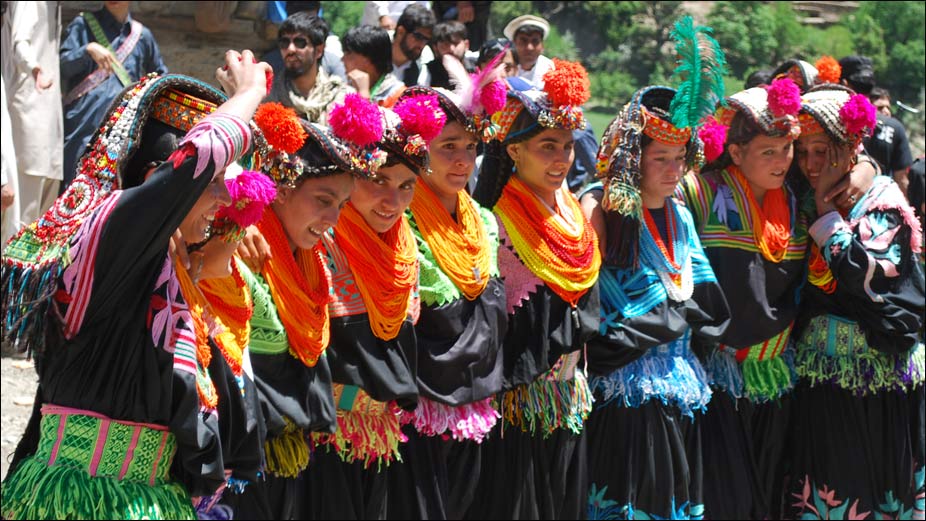
"Brargini, doy tazim"
(Brothers, he will give thanks.)
History of the Kalash
"I dedicate this page to my good friend, M. Bugi, his family, and to the
Kalash people ('mountain people'), located in a beautiful valley
high up in the Himalaya Mountains."
Kalash Blog
Lakshan Bibi speaking at the
UN regarding global warming
May 22, 2007
Articles
A Little Boy Said to His Mother
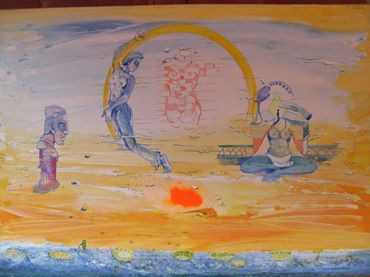
Bugi combines tradition and surrealism
Kalasha Peoples Call for Cultural Survival
Two-week Kalash festival kicks off
Main Menu

Chinese Calligraphy
by Lee Shouping
The Kalash in Quarantine
Mahraka.com
A Website on the Culture,
History and Languages of Chitral.
The Kalash or Kalasha, are an ethnic group found in the Hindu Kush mountain range in the Chitral district of the North-West Frontier Province of Pakistan. Although quite numerous before the twentieth century, this non-Muslim group has been partially assimilated by the larger Muslim majority of Pakistan and seen its numbers dwindle over the past century. Today, sheikhs, or converts to Islam, make up more than half of the total Kalasha-speaking population.
The culture of Kalash people is unique and differs drastically from the various ethnic groups surrounding them. They are polytheists and nature plays a highly significant and spiritual role in their daily life. As part of their religious tradition, sacrifices are offered and festivals held to give thanks for the abundant resources of their three valleys. Kalash mythology and folklore has been compared to that of ancient Greece, but they are much closer to Indo-Iranian (Vedic and pre-Zoroastrian) traditions.
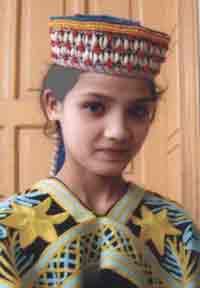
Wonderful To Pay Tributes to HISTORY, and there is No shame in admitting that Great Artists have Influenced me, Instead of Finding Easy routes for fame Fortune and Glory I LOVE my Teachers, as i call Myself a Student of History,lots of My works are There, to support one of Its Kind, he is a Master, Jamil Naqsh Was My Teacher in Pakistan, as well as Father of Danish Azar Zuby I learnt a Lot from Them,,as well as Multiple images Of Surrealism, Hieronymus Bosch the GREAT Master, and Of Course what u see here Is REMBRANDT-
Words Of Johanna from USA, half Greek Half American-(QUOTE). For several years now, i have been privileged to be a part of a movement in acknowledgment of Kalash and indigenous tribes by our dear one, MBugi....the incorporation of Mr. Wajid's choice of music enhances the beautiful/loving paintings MBugi presents to us; his love for people around the world is more than inspiring, it is uplifting! He encourages w/out his knowing....touches heart strings so deeply that one is lead to follow such a person so dedicated. MBugi's ability to coordinate and make possible to all the works of his lifetime. Most assuredly, he has and will leave such a legacy. I as well, include the children; who are our future. The children who come to us to learn with desire and he makes it possible for them to exhibit their feelings/emotions in to art in the finest ways. All who observe, come in to contact w/him are included in his tributes to his people of Pakistan. It IS humbling when after so many years he continues
INNOVATIONS OF REMBRANDT
Rembrandt Harmenszoon Van Rijn, who many consider the greatest artist of all time, learned all that was then known about oil painting while still a very young man, surpassing his teachers very early in his career, and then proceeded to add his own discoveries to the technical knowledge of his time. To this day Rembrandt’s best works remain unsurpassed, and serve as inspiration to those of us who paint. This being the case, any book on advanced techniques must address Rembrandt separately and at such length as the author's knowledge allows. What technical information Rembrandt was taught may be discerned by studying the works of his instructors, Jacob Isaacxszoon Van Swanenburch and Pieter Lastmann. Such study also immediately shows the genius of Rembrandt by the extent to which he so obviously surpassed them both, and by how early in his career he did so. Nonetheless, his training under them was an important factor in his artistic development,
Nonetheless, his training under them was an important factor in his artistic development, and should not be minimized, as both teachers seem to have possessed a working knowledge of the painting methods in use at that time. Various examples of Rembrandt's work show that he was not limited to any one technique, but employed them all, the choice depending on which approach best suited the subject in question, and for what purpose the painting was intended. His facility with all three of the aforementioned methods of painting soon led him to combine aspects of one with another, and to add innovations of his own.
*Sitarist is Nikhil Banerjee Raag Darbari *--
and I hope that you Will Write some thing please, as After the Petition is Finished i shall Continue for Promotion of Arts In Pakistan,__/\__
Vir Kashmiri ........quote,.......infatuating the lingering music in the background is gripping.....its still running.....
Vir Kashmiri ........Bugi ji you are sheer joy thank you greatly for your presence...
MBugi
it took me 40 Long Years to Compile Work as well as Collect These Images, and Syed Wajid Based in Dubai Chose and Gave structure to My Ideas, as Great Master and His association with Mughals was Attributed, Most Of the Western Press Hides his Copies for it Brings Prejudice against Him,, Copying Masters,I also Got a Cold Shoulder from Rembrandt Museum In Amsterdam---I carried On Regardless, RESULT is Here, Specially The last Letter from National College Of Arts Now we will Try to work On *FAIZ AMAN MELA* The Chitralis are still speaking today one of the oldest Indo-European languages in a relatively undiluted form. This is not surprising in view of the remoteness of their area. They are so far up in the Hindu Kush mountains that it would be almost impossible for an invader to conquer them. By far the lowest pass into Chitral is Lowari Top, which is over 10,000 feet high, too high for an invading army easily to cross. The path up the Kunar river from Jalalabad becomes so narrow below Ashret that no invading army has ever tried it. There have been several attempts to invade Chitral within relatively modern historical times. One group came across Boroghol Pass, were defeated and went back. Another group came across Urtsun Pass. The British in 1895 simultaneously came across Shandur Pass and Lowari Top in a mission to rescue a group British hostages which had been taken. They conquered the area, which is the reason why Chitral is now part of Pakistan.
The world's highest polo playground is located here. It is surrounded by some of the most spectacular mountains in the world. The history of this annual polo tournament at the Shandur Top dates back to 1936 when a British Political Agent, Major Cobb organised the first polo tournament here. Major Cobb was fond of playing polo under full moon and he developed a polo ground near Shandur that was named after him and is still known as 'Major Cobb Moony Polo Ground'. Polo fans gather at Shandur from all over the world to participate in the spectacular polo events during this tournament.
Mainland Pakistan refers to the people of Punjab, Sindh and Peshawar. The Kalash people and their way of life are being destroyed by tourism like this.
Modern progress should never be used at the expense of any peoples culture.
to do all we can to prevent this cultural loss.
The Kalash people will be forever grateful for all of your support!
Burushaski Song and Images of my adopted Kalash families, from MBugi Bugi Bugiandassociates.
Thank you. I hope that you will remember The Silk-Route is full of Poets, Stories and Songs:
Travelled from heart to heart before the actual writing were written,
I am very proud of the area, although I am not from there.
This is one of the best films I have seen about the Kalash and the people of the area of Chitral, Nager, Hunza.
In this small region more then 10 ancient Languages are spoken and the anthropologists are puzzled.
Mr George Morgersterine from Norway wrote in 1935 that the area has no parallel to other areas in the whole world,
with such richness in culture and so strong in history.
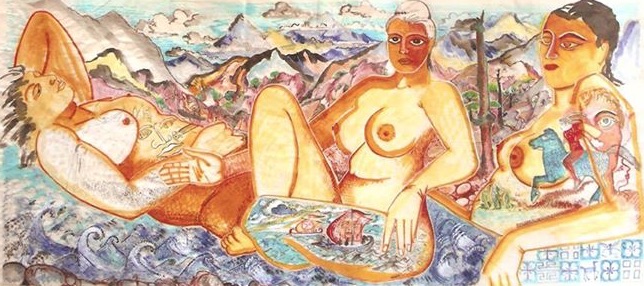
United Nations Deceninium
for Indiginous Peoples
1995 - 2004
THE KALASH
A LIVING PERSONIFICATION
MYTH AND HISTORY
The Sanskrit word "Kalash" means both pure and ashes, and according to the stories told by the Kalash to Bugi and his family in the last 40 years, we are created out of water to be pure.
Khudai, the supreme God, long ago, at the time of distributions among the sons of Adam, gave land to live on. Kalasha, the youngest son, decided with his family to keep the valley of Bamboorate for himself as this was the most beautiful and fertile valley in the whole world. The two other brothers, Katis and Bashagalis, became jealous when they saw that the most beautiful part had been given to the youngest son. And this is what caused the enimity between the different tribes of the Kalash: the Siah Posh (with black robe), the Surkh Posh (with red robe) and the Safed Posh (with white robe).
In time immemorial the Kalash were spread over the extensive borderlands of China, Afghanistan, Kashmir and Pakistan, which included the Hindukush mountains and valleys stretched from Wa'gal, Shatruma Desh, Trachingao, Shoowar, Badam, Lotdeh, Badamuk, Tar Chigal, Bijen Chäo, Bashagal in Nooristan to Kohistan of Swat and Dir, from the Kabul River Valley to Badakshan and Wakhan, along the Karakoram Highway (parts of the ancient Silk Route).
A says they are the last descendants of the soldiers of Alexander the Great of Macedonia (326 B.C.). Reasons for the legend was the fact that the Kalash know a number of seperate named gods and demons, under which one of them resembles like the Greek god of wine Bacchos. The real origin of the Kalash is obscure. Historians accompagnying Alexander after crossing the Lowari Top in Dir have mentioned small scrimmiges with the Kalash tribe. The centuries old rockcarvings along the Karakoram Highway are according to some anthropologists of Buddhist origin, but they could also be direction signs used by the trading shepherds living in the Kalash Kingdom. In the time of the Moghuls (rulers in this region in the 15th till the 19th century) wine was taken from the valleys of the Kalash to the tables of the moghuls. The Moghul Emperor Babur "the tiger" invaded the Kalash area because he did not recieve the taxes (Jizya).
The tribesmen who did not know the power of gunpowder were blazed away. They reacted, Babur said, with unseemly gestures. He introduced new taxes at the time of harvest, which was later abolished by Akbar (1504) with a sense of fairness, because he was a man of culture and wisdom.
Seeing the prosperity of the Kalash in the Bamboorate valley, Katis and Bashagalis became jealous. They invaded the valley several times. They killed many and took away golden and silver utencils and girls. The Kalash complained to the Amir of Chitral, Aman-Ulmulk. The Amir promised protection, in exchange of walnuttrees, honey, cheese, goats and women to work as housemaids in his palace. The inhabitants of the valleys of the Kalash area became the slaves of the Amir of Chitral. He did everything to keep them from education and nobody was allowed to hunt deer or mountain goats
Harkhor). There was some freedom though. Religious ceremonies were respected four times a year, and at the time of death and birth. Onesided treaties were signed as far as the water flows and the grass grew. The land belonged to the Amir and his family. The Kalash had nothing to say in it for they were the illiterate, the wild bunch. For little quantity of tobacco precious possession of the Kalash were disposed. By igorance and because of the high debts the Kalash lost their land to strangers in the end.
On the other side of the mountains in the valley of Barose and Shisikohn the wise king Bola Singa (ruler of the Kalash in the 17th century) had a dream. A giant appeared to him and said: "shoot these three arrows and let your soldiers find them again. Build a temple where the black arrow will come down. On the spot where the red arrow comes down you build a house, where the female may deliver their children and where they can live when they are unclean. [the Kalash consider women who are in labour and women who have their period as unclean, and it is their habit that they live in a seperate house, called Bashalani.] The third arrow will be saved for the future generations to come forth." As predicted by the wise, soon the Surkh Posh-Kalash would disappear. And so it happened. Amir Abdur Rehman, ruler of Afghanistan, invaded at the end of the 19th century the living area of the Surkh Posh-Kalash and converted 80.000 Kalash into Muslim. The name of the area changed from Kafiristan (land of the unbelievers) into Nooristan (land of the light).
The Brittish explorer Robertson (1890 - 1895) saw the last people of Kafiristan and notifyed about them in his book "Kafirs of the Hindukush. Katis and Bashagalis". Amir Abdu Rehman was armed to the teeth by the Brittish to prevent the Russians to reach a warm seaport. The war which was waged over small possessions became a fanatic religious war. People from Nooristan regularly invaded Bamboorate, Bireer and Rumboor. Sculptures were burned, houses broken down and everything which reminded of idolworship was taken away. So were the 200 sculptures which were taken to the British museums by Robertson and by the people who were caretakers of the British Empire for governing purposes.
The Kalash disappeared out of the picture. There was no education and no written language. All religious ceremonies were passed down from generation to generation by means of hymns and songs. While singing songs the high priest of Rumboor (Qazi Biraman, who is now 85 years old utters: "when I was a young boy there were 106 life size sculptures in Rumboor alone, where are they now? Oh my fellow Kalash warriors, beware these bounty hunters are not your friends". CULTURE
Wine, fruit, exotic women, fairy tales and gods, that is what it was all about in the Kalash Kingdom. A tribal chief was judged according to the number of goats he possessed. The highest cast and the people with royal blood, only possessed cows. After living a few months alone with his flock in the valleys a young boy became a man and a warrior. After this he could choose any girl he wanted. In future the man was named Ballalik (brave warrior).
Just like other pagan tribes of Indo-Arian origins, festivities were connected with the seasons, and the activities belonging to each season, like sowing, harvesting and storing the harvest, ment rejoicing and merry making. The early days remembered of the Promised Land, abundance of food and drink, clothes made out of goathair and age old customs in which respect for eachother was central. During harvesttime there was a feast which lasted for one week. There was dancing in the moonlight by the sound of the drums, while people with torches in their hands gathered on a spot specially meant for this feast. Even the children would be drunk then, and the girls sang lovesongs: "I would like to run away with you brave warrior, but don't tell my friends. I want to live with you. I want to marry you. How many goats and cows can you give to my parents, I will be yours." The boys answered on the changing rythm of the drums and sang: "What is the meaning of cows and goats if you have me. Don't look at my possessions. I am there to protect you. If my enemy gives five goats I will give twenty, for he can't beat me. I am the son of a great warrior". RECENT FACTS Uptil today there are still 2500 Kalash living in the three valleys in Pakistan: Bamboorate, Bireer and Rumboor, near Chitral, N.W.F.P. The Kalash consider the period under the rule of their kings Shalak Shah, Cheo, Raja Waii and Bola Singa as their best time. That was the golden time remembered by the Kalash. Trich Mir smiled like a golden god upon the bountiful land. Trich Mir, Chitrals highest peak, still towers high, only the days are no longer so golden......
The sons of the royal families tell with pride: "This was our land, but what should we do. Our ancestors in the evenings listened to the wings of the fairies passing by, while the drums were being played. What is left for us? Our land is taken by strangers, our trees are used as pledges for a cap, we live like animals in a zoo, where the spectators stare at us. We are forced to dance for strangers and our women are troubled. All we want is to be left alone."
The Kalash are skilled artisans. Just look at the patrons in harmony with nature all over. The paintings, the woodcarving and the wooven textiles. They are beautiful people, their women have long slender necks, the most delicate wrists and long tapering fingers. Childlike people, innocent. They hardly have any crime among them. They don't lie, they don't cheat and for the guests they go out of the way. But slowly they are forgetting everything. To honour their dead the Kalash make wooden sculptures (Gandaoo effigies), animals are sacrificed, feasts are given. So every artisan can compete for his family's name.
"I am the best carver in the whole valley", says Mirzamust, a sculpturer. And to celebrate the change of seasons, they paint the doors of their houses. Like Khishoo, the outstanding artist among the Kalash artisans.
But everything gets stolen, many things disappear to Europe, to museums of Anthropology and Ethnography. The Kalash never get any compensations. Moreover the healthsituation in the valleys is disastrous. Infant mortality is high, lack of elementary hygiene cause eye-infections among many other things. And last but not least outsiders always interfere with the Kalash.
At the time of Joshi (the Kalash festival in Rumboor), a priest from the west came with a bible in hand, and started shouting, raising slogans: "Oh I found the lost tribes of the Jews". The Government of Pakistan acted promptly and all religious preachings and lobbying were banned, to respect the Kalash sensibilities.
All this brings tears in the eyes of the Kalash. Like a chieftain of the Kalash, Laqbal Khan says: "Ex-prime-minister Mr. Bhutto loved us very much. He visited us and promised us museums to preserve our culture and to earn selfrespect. All we want is to be left alone, and carry out our religious- and human rights. In 1980 there were 5000 of us. Now, in 1995 only 2500 are left. These people, who are living in tents on the bank of Chitral River, are our brothers from Nooristan, who have returned from across the borders. We wanted to fight with them, hand in hand against the Soviets during the Afghan-war. Now the Soviets are gone, we can live in peace and harmony with nature again. All these refugees living near the mountainstreams are our familymembers. We don't have much, but we share with them whatever we have. The enemy is gone. Now help us to survive, for we were the test sites. Test sites of the games superpowers play with the poor countries."
Bugi Ansari
United Nations Deceninium
for Indiginous Peoples
Translation by Anita Ansari
Kalash Art Gallery

 >
>


The Chitralis are still speaking today one of the oldest Indo-European languages in a relatively undiluted form. This is not surprising in view of the remoteness of their area. They are so far up in the Hindu Kush mountains that it would be almost impossible for an invader to conquer them. By far the lowest pass into Chitral is Lowari Top, which is over 10,000 feet high, too high for an invading army easily to cross. The path up the Kunar river from Jalalabad becomes so narrow below Ashret that no invading army has ever tried it. There have been several attempts to invade Chitral within relatively modern historical times. One group came across Boroghol Pass, were defeated and went back. Another group came across Urtsun Pass.
"Un'e shule men fana o mannan unar begolel.
(Some one is longing for your love, but you don't know.)" Kalash Poem
The Chitralis are still speaking today one of the oldest Indo-European languages in a relatively undiluted form. This is not surprising in view of the remoteness of their area. They are so far up in the Hindu Kush mountains that it would be almost impossible for an invader to conquer them. By far the lowest pass into Chitral is Lowari Top, which is over 10,000 feet high, too high for an invading army easily to cross. The path up the Kunar river from Jalalabad becomes so narrow below Ashret that no invading army has ever tried it. There have been several attempts to invade Chitral within relatively modern historical times. One group came across Boroghol Pass, were defeated and went back. Another group came across Urtsun Pass. The British in 1895 simultaneously came across Shandur Pass and Lowari Top in a mission to rescue a group British hostages which had been taken. They conquered the area, which is the reason why Chitral is now part of Pakistan.
The world's highest polo playground is located here. It is surrounded by some of the most spectacular mountains in the world. The history of this annual polo tournament at the Shandur Top dates back to 1936 when a British Political Agent, Major Cobb organised the first polo tournament here. Major Cobb was fond of playing polo under full moon and he developed a polo ground near Shandur that was named after him and is still known as 'Major Cobb Moony Polo Ground'. Polo fans gather at Shandur from all over the world to participate in the spectacular polo events during this tournament.

History of the Kalash
History
The Kalash were ruled by the Mehtar of Chitral from the 1700s onward. They have enjoyed a cordial relationship with the major ethnic group of Chitral, the Kho who are Sunni and Ismaili Muslims. The multi-ethnic and multi-religious State of Chitral ensured that the Kalash were able to live in peace and harmony and practice their culture and religion. The Nuristani, their neighbors in the region of former Kafiristan west of the border, were invaded in the 1890s and converted to Islam by Amir Abdur-Rahman of Afghanistan and their land was renamed Nuristan.
Prior to that event, the people of Kafiristan had paid tribute to the Mehtar of Chitral and accepted his suzerainty. This came to an end with the Durand Agreement when Kafiristan fell under the Afghan sphere of Influence. Recently, the Kalash have been able to stop their demographic and cultural spiral towards extinction and have, for the past 30 years, been on the rebound. Increased international awareness, a more tolerant government, and monetary assistance has allowed them to continue their way of life. Their numbers remain stable at around 3,000. Although many convert to Islam, the high birth rate replaces them, and with medical facilities (previously there were none) they live longer.
Allegations of "immorality" connected with their practices have led to the forcible conversion to Islam of several villages in the 1950s, which has led to heightened antagonism between the Kalash and the surrounding Muslims. Since the 1970s, schools and roads were built in some valleys.
Kalash People Art Exhibit
Slideshow
About Children
by Kahlil Gibran
Your children are not your children.
They are the sons and daughters of Life's longing for itself.
They come through you but not from you,
And though they are with you yet they belong not to you.
You may give them your love but not your thoughts,
For they have their own thoughts.
You may house their bodies but not their souls,
For their souls dwell in the house of tomorrow,
which you cannot visit, not even in your dreams.
You may strive to be like them,
but seek not to make them like you.
For life goes not backward nor tarries with yesterday.
You are the bows from which your children
as living arrows are sent forth.
The archer sees the mark upon the path of the infinite,
and He bends you with His might
that His arrows may go swift and far.
Let your bending in the archer's hand be for gladness;
For even as He loves the arrow that flies,
so He loves also the bow that is stable.
Outstanding Videos:
All My Relatives
Cave art by ancient Uyghurs
Homage to the Kalash People
Into the Breach for Alexander's Descendants
Joshi Festival
Kalash Wedding (2008)
Poem:
"This I burn as an offering.
Behold it!
A sacred praise I am making.
A sacred praise I am making.
My nation, befold it in kindness!
The day of the sun has been my strength.
The path of the moon shall be my robe.
A sacred praise I am making.
A sacred praise I am making."
By: M. Bugi
Encyclopaedia Britannica: Hindu-Kush
Google Photo Archive
Heart of Gandhara Civilization
Journey to Chitral
Proceedings of the Third International
Hindu Kush Cultural Conference
Khowar is the language of the Kalash tribe, spoken in Chitral, which is in the far Northwest corner of Pakistan; a beautiful valley in the Hindukush range of Mountains. Khowar is classified as an Indo-European language of the Dardic Group. However, only Kalashamun is closely related to Khowar. It is spoken as the primary language by 250,000 people in Chitral. There are also pockets of speakers in Gilgit. It is clear that the current Chitralis have lived in their mountain home for 3,000 to 4,000 years.The people of Chitral are called Kho. Traditionally they are peaceful and law abiding citizens.
Khowar has 42 phonemes. Several of these are not found in any other language of the region. The letters /t/, /th/, /d/, /l/, /sh/, /ch/, /chh/, and /j/ all have two different forms, one retroflexed and the other dential-veolar non-retroflexed. Every Chitrali who learned the language on his mother's knee can readily distinguish these forms, whereas others can never learn them, regardless of how long they have lived in Chitral.
Links to the Kalash People
Google Search
History of Chitral
Kalash: Wikipedia
Parks
The Kalash Tribe
Khowar does not have a written form in common use. Before 1947, written communications in Chitral were in Farsi, which explains the large number of Farsi loan words. Today, written communications are in Urdu. Several attempts have been made to introduce a Urdu or Roman based writing script into Khowar, but these have never gained widespread acceptance.
Alexander the Great encountered them when he visited the area. The proof of this is that in the histories of Alexander the Great it is written that he encountered strange wooden boxes, which his troops chopped up to be used as firewood. These "boxes" were actually coffins for their dead following the custom which the Kalash Kafirs of Chitral still have of leaving their dead outside in wooden coffins. He also described them as a light skinned race of European type people, which is exactly what they are. This further proves that the same people were there then as are there now.
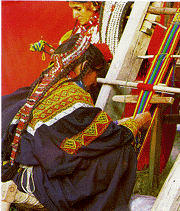
The Kalash Kafir religion which is still practiced today by about 3,000 people in Chitral has a resemblance to the ancient Greek religion of gods and goddesses. This has led some to speculate that the Kalash got their religion from the invading Greeks. This is unlikely. The Greeks merely passed through in 327 B.C., probably within 50 miles of Chitral, but did not enter Chitral itself and did not stop or stay for long. What is likely is that the Kalash religion and the Greek religion have a common origin. Both came from some proto-Indo European religion which was carried along with the Indo European language when the Chitralis first got there some 3,000 to 4,000 years ago.
The Chitralis are still speaking today one of the oldest Indo-European languages in a relatively undiluted form. This is not surprising in view of the remoteness of their area. They are so far up in the Hindu Kush mountains that it would be almost impossible for an invader to conquer them. By far the lowest pass into Chitral is Lowari Top, which is over 10,000 feet high, too high for an invading army easily to cross. The path up the Kunar river from Jalalabad becomes so narrow below Ashret that no invading army has ever tried it. There have been several attempts to invade Chitral within relatively modern historical times. One group came across Boroghol Pass, were defeated and went back. Another group came across Urtsun Pass. The British in 1895 simultaneously came across Shandur Pass and Lowari Top in a mission to rescue a group British hostages which had been taken. They conquered the area, which is the reason why Chitral is now part of Pakistan.
The world's highest polo playground is located here. It is surrounded by some of the most spectacular mountains in the world. The history of this annual polo tournament at the Shandur Top dates back to 1936 when a British Political Agent, Major Cobb organised the first polo tournament here. Major Cobb was fond of playing polo under full moon and he developed a polo ground near Shandur that was named after him and is still known as 'Major Cobb Moony Polo Ground'. Polo fans gather at Shandur from all over the world to participate in the spectacular polo events during this tournament.
The Kalash Valley of Rumbur
Chitral - Pakistan - June 2006
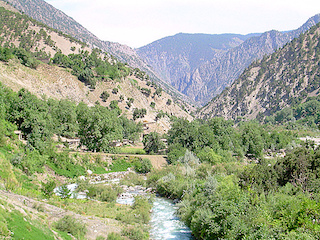
The Kalash (Urdu: Nuristani: Kasivo) or Kalasha, are indigenous people of the Hindu Kush mountain range, residing in the Chitral district of the North-West Frontier Province of Pakistan. They speak the Kalash language, from the Dardic family of Indo-Iranic, and are considered a unique tribe among the Indo-Aryan stock. mology
According to the linguist Richard Strand, the people of Chitral apparently adopted the name of the former Kafiristan Kalasha, who at some unknown time extended their influence into Chitral. A reference for this assumption could be the names kâsv'o respectively kâsi'o, used by the neighboring Nuristani Kata and Kom for the Kalash of Chitral. From these the earlier name kâs'ivo (instead Kalasha) could be derived
The culture of Kalash people is unique and differs drastically from the various ethnic groups surrounding them. They are polytheists and nature plays a highly significant and spiritual role in their daily life. As part of their religious tradition, sacrifices are offered and festivals held to give thanks for the abundant resources of their three valleys[3]. Kalash mythology and folklore has been compared to that of ancient Greece, but they are much closer to Indo-Iranian (Vedic and pre-Zoroastrian) traditions
The language of the Kalash is a Dardic language belonging to the Indo-Aryan branch of the Indo-Iranian group; itself part of the larger Indo-European family. It is classified as a member of the Chitral sub-group, the only other member of that group being Khowar. The Norwegian Linguist Georg Morgenstierne who studied both languages wrote that in spite of similarities Kalasha is an independent language in its own right, not a mere dialect of Khowar. Currently about 5,000 people speak Kalasha and it is considered critically endangered by UNESCO. Badshah Munir Bukhari unicoded the Kalasha Language in 2005. Working in close collaboration with various international researchers and linguists, Kalash linguist Taj Khan Kalash organized first "Kalasha Orthography Conference 2000"in Islamabad Pakistan. In 2004 he was able to raise funds to publish first alphabet book of Kalasha language based on Roman script designed by an Australian linguist Gregory R. Cooper.
There is some controversy over what defines the ethnic characteristics of the Kalash. Although quite numerous before the 20th century, the non-Muslim minority has seen its numbers dwindle over the past century. A leader of the Kalash, Saifulla Jan, has stated, "If any Kalash converts to Islam, they can't live among us anymore. We keep our identity strong."[9] About three thousand have converted to Islam or are descendants of converts, yet still live nearby in the Kalash villages and maintain their language and many aspects of their ancient culture. By now, sheikhs, or converts to Islam, make up more than half of the total Kalasha-speaking population.
Kalash women usually wear long black robes, often embroidered with cowrie shells. For this reason, they are known in Chitral as "The Black Kafirs". Men have adopted the Pakistani shalwar kameez, while children wear small versions of adult clothing after the age of four.
In contrast to the surrounding Pakistani culture, the Kalash do not in general separate males and females or frown on contact between the sexes. However, menstruating girls and women are sent to live in the "bashaleni", the village menstrual building, during their periods, until they regain their "purity". They are also required to give birth in the bashaleni. There is also a ritual restoring "purity" to a woman after childbirth which must be performed before a woman can return to her husband.[11] The husband is an active participant in this ritual.
Marriage by elopement is rather frequent, also involving women who are already married to another man. Indeed, wife-elopement is counted as one of the "great customs" (gho¯na dastu¯r) together with the main festivals.
Girls are usually married at an early age. If a woman wants to change husbands, she will write a letter to her prospective husband offering herself in marriage and informing the would-be groom how much her current husband paid for her. This is because the new husband must pay double if he wants her. For example, if the current husband paid one cow for her, then the new husband must pay two cows to the original husband if he wants her.
Wife-elopement may lead in some rare cases to a quasi-feud between clans until peace is negotiated by mediators, in the form of the double bride-price paid by the new husband to the ex-husband.
Kalash lineages (kam) separate as marriageable descendants have separated by over seven generations. A rite of "breaking agnation" (tatbr¹e c¹hin) marks that previous agnates (tatbr¹e) are now permissible affines (därak "clan partners).[12] Each kam has a separate shrine in the clan's Je¯??ak-ha¯n, the temple to lineal or familial goddess Jeak.
The three main festivals (khawsá?gaw) of the Kalash are the Joshi festival in late May, the Uchau in autumn, and the Caumus in midwinter.
The pastoral god Sorizan protects the herds in Fall and Winter and is thanked at the winter festival, while Goshidai does so until the Pul festival (pu˜. from *pu¯r?a, full moon in Sept.) and is thanked at the Joshi (jo?i, z¹o¯s¹i) festival in spring.
Joshi is celebrated at the end of May each year. The first day of Joshi is "Milk Day", on which the Kalash offer libations of milk that have been saved for ten days prior to the festival.
The most important Kalash festival is the Chaumos (cawmo¯s, ghona chawmos yat, Khowar "chitrimas" from *ca¯turma¯sya, CDIAL 4742), which is celebrated for two weeks at winter solstice (c. Dec. 7-22), at the beginning of the month chawmos mastruk. It marks the end of the year's fieldwork and harvest. It involves much music, dancing, and the sacrifice of many goats. It is dedicated to the god Balimain who is believed to visit from the mythical homeland of the Kalash, Tsyam (Tsiyam, tsíam), for the duration of the feast. Food sacrifices are offered at the clans' Jeshtak shrines, dedicated to the ancestors.A Kalash man dances during the Uchau FestivalAt Chaumos, impure and uninitiated persons are not admitted; they must be purified by a waving a fire brand over women and children and by a special fire ritual for men, involving a shaman waving juniper brands over the men. The 'old rules' of the gods (Devalog, dewalo¯k) are no longer in force, as is typical for year-end and carnival-like rituals. The main Chaumos ritual takes place at a Tok tree, a place called Indra's place, "indrunkot", or "indréyin". Indrunkot is sometimes believed to belong to Balumain's brother, In(dr), lord of cattle. [15] Ancestors, impersonated by young boys (o¯nje??a 'pure') are worshipped and offered bread; they hold on to each other and form a chain (cf. the Vedic anva¯rambha?a) and snake through the village.
The men must be divided into two parties: the pure ones have to sing the well-honored songs of the past, but the impure sing wild, passionate, and obscene songs, with an altogether different rhythm. This is accompanied by a 'sex change': men dress as women, women as men (Balumain also is partly seen as female and can change between both forms at will).
This includes the Festival of the Budulak (bu?á?ak, the 'shepherd king'). In this festival, a strong prepubescent boy is sent up into the mountains to live with the goats for the summer. He is supposed to get fat and strong from the goat milk. When the festival comes he is allowed for a 24-hour period only to have sexual intercourse with any woman he wants, including even the wife of another man, or a young virgin or his own mother if he wants her. Any child born of this 24-hour rampage is considered to be blessed. The Kalash claim to have abolished this practice in recent years due to negative worldwide publicity.
At this crucial moment the pure get weaker, and the impure try to take hold of the (very pure) boys, pretend to mount them "like a hornless ram", and proceed in snake procession. At this point, the impure men resist and fight. When the "nagayro¯" song with the response "han sarías" (from *samri¯yate 'flows together', CDIAL 12995) is voiced, Balumain showers all his blessings and disappears. He gives his blessings to seven boys (representing the mythical seven of the eight Devalog who received him on arrival), and these pass the blessings on to all pure men.
In myth, Mahandeu had cheated Balumain from superiority, when all the gods had slept together (a euphemism) in the Shawalo meadow; therefore, he went to the mythical home of the Kalash in Tsiyam (tsíam) , to come back next year like the Vedic Indra (Rigveda 10.86). If this had not happened, Balumain would have taught humans how to have sex as a sacred act. Instead, he could only teach them fertility songs used at the Chaumos ritual. He arrives from the west, the (Kati Kafir) Bashgal valley, in early December, before solstice, and leaves the day after. He was at first shunned by some people, who were annihilated. He was however, received by seven Devalog and they all went to several villages, such as Batrik village, where seven pure, young boys received him whom he took with him. Therefore, nowadays, one only sends men and older boys to receive him. Balumain is the typical culture hero. He told people about the sacred fire made from junipers, about the sowing ceremony for wheat that involved the blood of a small goat, and he asked for wheat tribute (hushak) for his horse. Finally, Balumain taught how to celebrate the winter festival. He was visible only during his first visit, now he is just felt to be present.
Kalash culture and belief system differs from the various ethnic groups surrounding them but is similar to that of the neighboring Nuristanis in northeast Afghanistan, before their enforced Islamization in the last decade of the 19th century. The Kalash people are unique in their customs and religion.
There is a creator deity called Dezau (ezáw) whose name is derived from Indo-European *dheig'h 'to form' (cf. Vedic dih, Kati Nuristani dez 'to create', CDIAL 14621); he is also called by the Pashto term Khodai. There are a number of other deities, semi-gods and spirits. The Kalash pantheon is thus one of the last living representatives of Indo-European religion, along with Hinduism and Zoroastrianism.
There is the prominent Indr or Varendr (Warín, Werín from *aparendra); the rainbow (indré~ CDIAL 1577) is called "Indra's bow" as in Vedic; when it thunders, Indra plays Polo. Indra is attested both in Vedic and Avestan texts and goes back to Indo-Iranian deity V?trahan the 'slayer of vtra' (resistance).
Indra appears in various form, such as Sajigor (Sajigo¯r), also called Shura Verin (S¹úra Werín from *s´u¯ra *aparendra 'the hero, the unrivaled Indra'). Warén(dr-) or In Wari¯n is the mightiest and most dangerous god. The location of his shrine was assigned by bow shot, which recalls the Vedic Indra's Bunda bow . Another one of his forms is the recently popular Balumain (Ba?imaín). Riding on a horse, comes to the Kalash valleys from the outside at winter solstice. Balumain is a culture hero who taught how to celebrate the Kalash winter festival (Chaumos). He is connected with Tsyam, the mythological homeland of the Kalash. Indra has a demon-like counterpart, Jean (from *jyeha? 'the best'), who appears on earth as a dog; the gods (Devalog, Dewalók) are his enemies and throw stones at him, the shooting stars.
Another god, Munjem Malik (munjem from *madhyama 'middle'; malék from Arab. malik 'king'), is the Lord of Middle Earth and killed, like the Vedic Indra, his father. Mahandeo (mahandéo, cf. the Nuristani Mon/Ma¯ndi, from *maha¯n deva), is the god of crops, and also the god of war and a negotiator with the highest deity.
Jestak (jéak, from *jyeha¯, or *deri¯?) is the goddess of domestic life, family and marriage. Her lodge is the women's house (Jeak Han).
Dezalik (?izálik), the sister of "Dezau" is the goddess of childbirth, the hearth and of life force; she protects children and women. She is similar to the Kafiri Nirmali (Indo-Iranian *nirmalika¯). She is also responsible for the Bashaleni lodge.
There also is a general pattern of belief in mountain fairies, Suchi (súc¹i, now often called Peri), who help in hunting and killing enemies, and the Varo¯ti (~ Sanskrit Va¯taputra), their violent male partners (echoing the Vedic Apsaras and Gandharvas). They live in the high mountains, such as Tirich Mir (~ Vedic Meru, *devameru: Shina díamer, CDIAL 6533), but in late autumn they descend to the mountain meadows. The Jach (j.ac. from *yak?(ini¯), are a separate category of female spirits of the soil or of special places, fields and mountain pastures.
There is some confusion regarding to the present status of the Kalash, as some sources are stating that Islamic fundamentalists have converted all the Kalash, while some other sources stating that there are still some pagan Kalash remaining. According to the latter source, during the seventies, when local Muslims forced a number of conversions upon the Kalash, their numbers shrank to just two thousand. However, with protection from the government, a decrease in voluntary conversion and a great reduction in the child mortality rate, the last two decades have seen their numbers double.
Recently there was some controversy when two Kalash girls converted to Islam.
These deities have shrines throughout the valleys, where they frequently receive goat sacrifices. In 1929, as Georg Morgenstierne testifies, such rituals were still carried out by Kalash priests, "is¹tikavan" 'priest' (from is¹tikhék 'to praise a god'). This institution has since disappeared but there still is the prominent one of shamans (dehar). The deities are temporary visitors. Kalash shrines (du¯r 'house', cf. Vedic dúr) are a wooden board or stone altar at juniper, oak, cedar trees, in 1929 still with the effigy of a human head inside holes in these shrines. Horses, cows, goats and sheep were sacrificed. Wine is a sacred drink of Indr, who owns a vineyard that he defends against invaders. Kalash ritual is of potlatch type; by organizing rituals and festivals (up to 12; the highest called biramo¯r) one gains fame and status. As in the Veda, the former local artisan class was excluded from public religious functions.
However, there is a special role for prepubescent boys, who are treated with special awe, combining pre-sexual behavior and the purity of the high mountains, where they tend goats for the summer month. Purity is very much stressed and centered around altars, goat stables, the space between the hearth and the back wall of houses and in festival periods; the higher up in the valley, the more pure the location.
By contrast, women (especially during menstruation and giving birth), as well as death and decomposition and the outside (Muslim) world are impure, and, just as in the Veda and Avesta, many cleansing ceremonies are required if impurity occurs.
Crows represent the ancestors, and are frequently fed with the left hand (also at tombs), just as in the Veda. The dead are buried above ground in ornamented wooden coffins. Wooden effigies are erected at the graves of wealthy or honoured people.
The Kalash are known as indigenous people of Chitral, and their ancestors migrated to Chitral from Afghanistan in the 2nd century BC. It is thought the Kalash descendants migrated to Afghanistan from a distant place in South Asia, which the Kalash call “Tsiyam” in their folk songs and epics.
The Kalash were ruled by the Mehtar of Chitral from the 1700s onward. They have enjoyed a cordial relationship with the major ethnic group of Chitral, the Kho who are Sunni and Ismaili Muslims. The multi-ethnic and multi-religious State of Chitral ensured that the Kalash were able to live in peace and harmony and practice their culture and religion. The Nuristani, their neighbours in the region of former Kafiristan west of the border, were converted to Islam by Amir Abdur-Rahman of Afghanistan in the 1890s and their land was renamed Nuristan.
Prior to that event, the people of Kafiristan had paid tribute to the Mehtar of Chitral and accepted his suzerainty. This came to an end with the Durand Agreement when Kafiristan fell under the Afghan sphere of Influence. Recently, the Kalash have been able to stop their demographic and cultural spiral towards extinction and have, for the past 30 years, been on the rebound. Increased international awareness, a more tolerant government, and monetary assistance has allowed them to continue their way of life. Their numbers remain stable at around 3,000. Although many convert to Islam, the high birth rate replaces them, and with medical facilities (previously there were none) they live longer.
Allegations of "immorality" connected with their practices have led to the forcible conversion to Islam of several villages in the 1950s, which has led to heightened antagonism between the Kalash and the surrounding Muslims. Since the 1970s, schools and roads were built in some valleys.
Rehman and Ali (2001) report that pressure of radical Muslim organizations is on the increase:
Ardent Muslims on self-imposed missions to eradicate idolatry regularly attack those engaged in traditional Kalash religious rituals, smashing their idols. The local Mullahs and the visiting Tableghi Jammaites remain determined to 'purify' the Kafirs.
Located in the North-West Frontier Province of Pakistan, the Kalash people live in three isolated mountain valleys: Bumboret (Kalash: Mumret), Rumbur (Rukmu), and Birir (Biriu). These valleys are opening towards the Kunar River, some 20 km south (downstream) of Chitral, The Bumboret and Rumbur valleys join at 35°44?20?N 71°43?40?E? / ?35.73889°N 71.72778°E? / 35.73889; 71.72778 (1640 m), joining the Kunar at the village of Ayrun (35°42?52?N 71°46?40?E? / ?35.71444°N 71.77778°E? / 35.71444; 71.77778, 1400 m) and they each rise to passes connecting to Afghanistan's Nuristan Province at about 4500 m.
The Birir valley opens towards the Kunar at the village of Gabhirat (35°40?8?N 71°45?15?E? / ?35.66889°N 71.75417°E? / 35.66889; 71.75417, 1360 m). A pass connects the Birir and Bumboret valleys at about 3000 m. The Kalash villages in all three valleys are located at a height of approximately 1900 to 2200 m.
The region is extremely fertile, covering the mountainside in rich oak forests and allowing for intensive agriculture, despite the fact that most of the work is done not by machinery, but by hand. The powerful and dangerous rivers that flow through the valleys have been harnessed to power grinding mills and to water the farm fields through the use of ingenious irrigation channels. Wheat, maize, grapes (generally used for wine), apples, apricots and walnuts are among the many foodstuffs grown in the area, along with surplus fodder used for feeding the livestock.
The climate is typical of high elevation regions without large bodies of water to regulate the temperature. The summers are mild and agreeable with average maximum temperatures between 23° and 27°C (73° - 81°F). Winters, on the other hand, can be very cold, with average minimum temperatures between 2° and 1°C (36° - 34°F). The average yearly precipitation is 700 to 800 mm (28 - 32 inches).
Rosenberg et al. (2006) ran simulations dividing autosomal gene frequencies in selected populations into a given number of clusters. For 7 or more clusters, a cluster (yellow) appears which is nearly unique to the Kalash. Smaller amounts of Kalash gene frequencies join clusters associated with Europe and Middle East (blue) and with South Asia (red).Some in the academic community have speculated that the Kalash might be from ancient Middle Eastern populations, an indigenous population from South Asia, or members of Alexander the Great's army. Though often overstated, instances of blond hair or light eyes are not uncommon.
In a 2005 study of ASPM gene variants, Mekel-Bobrov et al. found that the Kalash people of Pakistan have among the highest rate of the newly-evolved ASPM haplogroup D, at 60% occurrence of the approximately 6,000-year-old allele.[28].
The Kalash also have been shown to exhibit the exceedingly rare 19 allele value at autosomal marker D9S1120 at a frequency higher than the majority of other world populations which do have it.
Firasat et al. (2006) conclude that the Kalash lack typical Greek haplogroups (e.g. haplogroup 21), On the other hand, a study by Qamar et al. (2002) found that even though "no support for a Greek origin of their Y chromosomes was found" in the Kalash, Greek y-chromosome admixture could be as high as 20% to 40%. Considering the apparent absence of haplogroup 21 in the local population, one of the possibilities suggested was because of genetic drift. On the basis of Y chromosome allele frequency, some researchers describe the exact Greek contribution to Kalash as unclear.
Another study with Qasim Ayub, and S. Qasim Mehdi, and led by Quintana-Murci claims that "the western Eurasian presence in the Kalash population reaches a frequency of 100%, the most prevalent [mtDNA] haplogroup being U4, (pre-HV)1, U2e, and J2," and that they show "no detectable East or South Asian lineages. The outlying genetic position is seen in all analyses. Moreover, although this population is composed of western Eurasian lineages, the most prevalent ... are rare or absent in the surrounding populations and usually characterize populations from Eastern Europe, the middle East and the Caucasus... All these observations bear witness to the strong effects of genetic drift of the Kalash population... However, a western Eurasian origin for this population is likely, in view of their maternal lineages, which can ultimately be traced back to the Middle East".
The estimates by Qamar et al. of Greek admixture has been dismissed by Toomas Kivisild et al. (2003): “some admixture models and programs that exist are not always adequate and realistic estimators of gene flow between populations ... this is particularly the case when markers are used that do not have enough restrictive power to determine the source populations ... or when there are more than two parental populations. In that case, a simplistic model using two parental populations would show a bias towards overestimating admixture”.
The study came to the conclusion that the Pakistani Kalash population estimate by (Qamar et al. 2002) “is unrealistic and is likely also driven by the low marker resolution that pooled southern and western Asian–specific Y-chromosome haplogroup H together with European-specific haplogroup I, into an uninformative polyphyletic cluster 2”.
A study by Rosenberg et al. (2006) employing genetic testing among the Kalash population concluded that they are, in fact, a distinct (and perhaps aboriginal) population with only minor contributions from outside peoples. In one cluster analysis with (K = 7), the Kalash formed one cluster, the others being Africans, Europeans/Middle Easterners/South Asians, East Asians, Melanesians, and Native Americans.
A genetic study published led by Firasat (2007) on Kalash individuals found high and diverse frequencies of :Haplogroup L3a (22.7%), H1* (20.5%), R1a (18.2%), G (18.2%), J2 (9.1%), R* (6.8%), R1* (2.3%), and L* (2.3%). Haplogroup L originates from prehistoric South Asia.
In the recent study: "Worldwide Human Relationships Inferred from Genome-Wide Patterns of Variation (2008)", geneticists using more than 650,000 single nucleotide polymorphisms (SNP) samples from the Human Genome Diversity Panel, found deep rooted lineages that could be distinguished in the Kalash. The results showed them not only to be distinct, but perfectly clustered within the Central/South Asian populations at (K = 7). The study also showed the Kalash to be a separated group, with having no membership within European populations.
Historically a goat herding and subsistence farming people, the Kalash are moving towards a cash-based economy whereas previously wealth was measured in livestock and crops. Tourism now makes up a large portion of the economic activities of the Kalash. To cater to these new visitors, small stores and guest houses have been erected, providing new luxury for visitors of the valleys. People attempting to enter the valleys have to pay a toll to the Pakistani government, which is used to preserve and care for the Kalash people and their culture.
Reference
Conservation of an Endangered Minority
Ethnic Cleansing of the Kafirs in Pakistan
Enclaved Knowledge
Genebase Tutorials
Worldwide Human Relationships Inferred from Genome
"I dedicate this page to my good friend, M. Bugi, his family, and to the Kalash people ('mountain people') high up in the Himalaya Mountains.."
Kalash Literature
in UrduKhowar is the language of the Kalash tribe, spoken in Chitral, which is in the far Northwest corner of Pakistan; a beautiful valley in the Hindukush range of Mountains. Khowar is classified as an Indo-European language of the Dardic Group. However, only Kalashamun is closely related to Khowar. It is spoken as the primary language by 250,000 people in Chitral. There are also pockets of speakers in Gilgit. It is clear that the current Chitralis have lived in their mountain home for 3,000 to 4,000 years.The people of Chitral are called Kho. Traditionally they are peaceful and law abiding citizens.
Khowar has 42 phonemes. Several of these are not found in any other language of the region. The letters /t/, /th/, /d/, /l/, /sh/, /ch/, /chh/, and /j/ all have two different forms, one retroflexed and the other dential-veolar non-retroflexed. Every Chitrali who learned the language on his mother's knee can readily distinguish these forms, whereas others can never learn them, regardless of how long they have lived in Chitral.
Khowar does not have a written form in common use. Before 1947, written communications in Chitral were in Farsi, which - explains the large number of Farsi loan words. Today, written communications are in Urdu. Several attempts have been made to introduce a Urdu or Roman based writing script into Khowar, but these have never gained widespread acceptance.
Alexander the Great encountered them when he visited the area. The proof of this is that in the histories of Alexander the Great it is written that he encountered strange wooden boxes, which his troops chopped up to be used as firewood. These "boxes" were actually coffins for their dead following the custom of the Kalash Kafirs of Chitral.
Who are the Kalash?
The Chitralis are still speaking today one of the oldest Indo-European languages in a relatively undiluted form. This is not surprising in view of the remoteness of their area. They are so far up in the Hindu Kush mountains that it would be almost impossible for an invader to conquer them. By far the lowest pass into Chitral is Lowari Top, which is over 10,000 feet high, too high for an invading army easily to cross. The path up the Kunar river from Jalalabad becomes so narrow below Ashret that no invading army has ever tried it. There have been several attempts to invade Chitral within relatively modern historical times. One group came across Boroghol Pass, were defeated and went back. Another group came across Urtsun Pass.
"Un'e shule men fana o mannan unar begolel.
(Some one is longing for your love, but you don't know.)" Kalash Poem


Comments
Post a Comment